
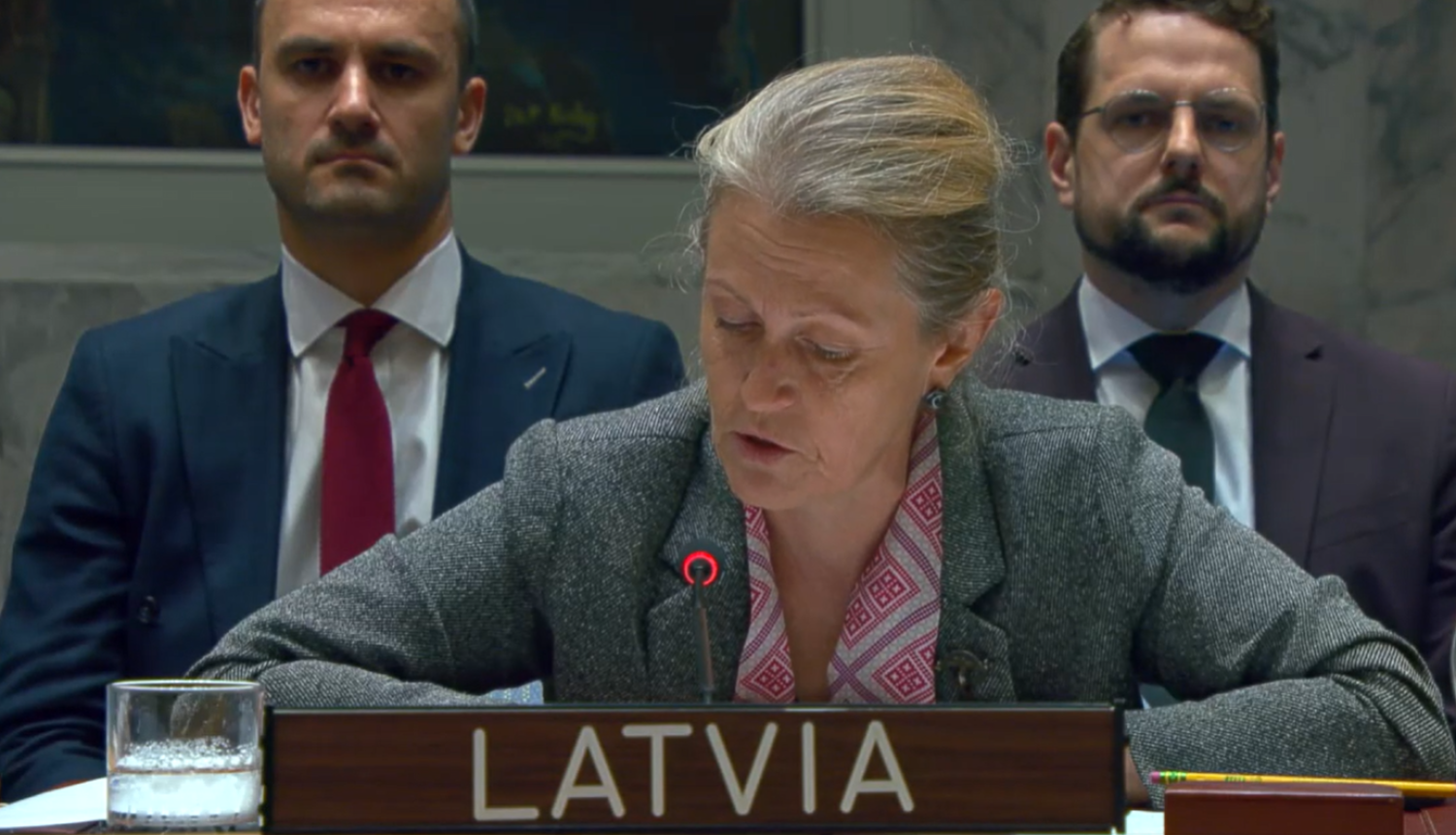
Thank you, President,
Allow me to begin by thanking Greece for organizing this debate on a topic of growing importance, as both themes – emerging technologies and maritime security – have firmly established themselves on the Council’s agenda. We welcome the presiding of this meeting by His Excellency, Mr. Kyriakos Mitsotakis, Prime Minister of the Hellenic Republic, and thank the distinguished briefers – Mr. Courtenay Rattray, Mr. Fareed Zakaria, and Mr. Michail Bletsas – for their valuable contributions.
Excellency,
We examine the issue of emerging technologies in the maritime domain against the backdrop of malign actors increasingly challenging the international norms governing maritime trade and navigation, with the Black Sea, the Strait of Hormuz, and the Red Sea serving as the most prominent examples.
Russia continues escalating its unlawful strikes against civilian shipping and port infrastructure in the Black Sea, targeting civilian vessels, even those flagged and owned by third countries, and crucially targeting grain supplies, desperately needed around the globe. Russia has weaponised drones, uncrewed systems, and artificial intelligence-powered targeting systems to conduct strikes against civilian merchant ships. We express solidarity with Ukraine, Romania, Bulgaria, Türkiye, Azerbaijan, India, our fellow Council members, Greece, Liberia and Panama, and other countries affected by Russian attacks on civilian shipping. And with the millions of people around the world, whose food security has been destabilised by the Russian attacks and naval blockade.
Iran has been trying to restrict free and safe passage through the Strait of Hormuz, an international waterway hosting countless crucial supply chains, striking commercial vessels just as it has been striking civilian infrastructure in its neighbouring states in the Gulf and beyond, in direct violation of Council Resolution 2817 and international law. Worryingly, we are also seeing a similar pattern re-emerging in the Red Sea and around the Bab-El-Mandeb Strait. Latvia is committed to supporting allied efforts to restore freedom of navigation.
These actions share a disgraceful strategy of trying to gain geopolitical advantage at the expense of vulnerable populations in other parts of the world, in complete disregard of international law and the humanitarian and economic consequences. They affect the most vulnerable parts of our global community, especially in active conflict zones with humanitarian emergencies. This means that millions more are facing acute food insecurity, and these consequences will last even after complete freedom of navigation is restored.
Indeed, fast developing emerging technologies present novel risks in the maritime domain, when used for malicious purposes.
They contribute to the growing asymmetric threat landscape by perfecting the tracking and targeting of vessels and offering new unmanned weapons systems to carry out attacks. They can be instrumentalized for disrupting navigational systems and digital port infrastructures through unlawful cyberattacks. Yet, simultaneously, these technologies also hold the promise of better defence against existing and emerging vectors of attacks. Tracking pirates, smugglers and “shadow fleet” vessels, at sea and through digital registries, or improving early warning systems for industrial accidents or even natural disasters – emerging technologies can be a tremendous asset. They are also crucial in hardening our cyberinfrastructure and may potentially aid in safeguarding our subsea cable infrastructure.
Excellency,
To ensure maritime security and navigational freedom and to decrease the likelihood of emerging technologies being used for causing harm at sea, we must take concrete steps. This includes strengthening the implementation of international law at sea, as reflected in the United Nations Convention on the Law of the Sea and international humanitarian law. International waterways are governed by clear legal principles and no political considerations or technological developments may be allowed to interfere with freedom of navigation. Increased awareness-raising and coordination at all levels is also needed, most notably within the IMO, but also ITU, regional organizations and other fora, while keeping the Security Council seized on threats that undermine navigational rights and freedoms.
The developments in the maritime domain present an important and expanding dimension of the overall implications of new and emerging technologies for the maintenance of international peace and security. Therefore, our ability to adequately respond to maritime security challenges will depend on our overall adaptation in light of technological developments. We believe that the Council should remain actively engaged in these efforts. Last week Latvia and Greece together with eight other Council members decided to convene an Informal Expert Group of the Security Council members on technology and peace and security. The Group will seek to improve Council’s ability to consider the implications of emerging technologies for its work. This will help the Council to be better equipped in addressing emerging threats in all domains, including maritime. To address both maritime disruptions and risks from emerging technologies, we must also work with the private sector to establish criteria, explore redundancies, determine alternatives and identify regulatory gaps before the next crisis arrives.
Excellency,
Let me conclude with a call on two fronts. First, we reiterate the crucial need for an immediate cessation of attacks against lawful civilian shipping and port infrastructure. And secondly, we must cooperate on the safe and secure development of emerging technologies, to maintain adherence to international law and support international peace and security in the maritime domain and beyond.
I thank you!