
Madam Chair,
Distinguished delegates,
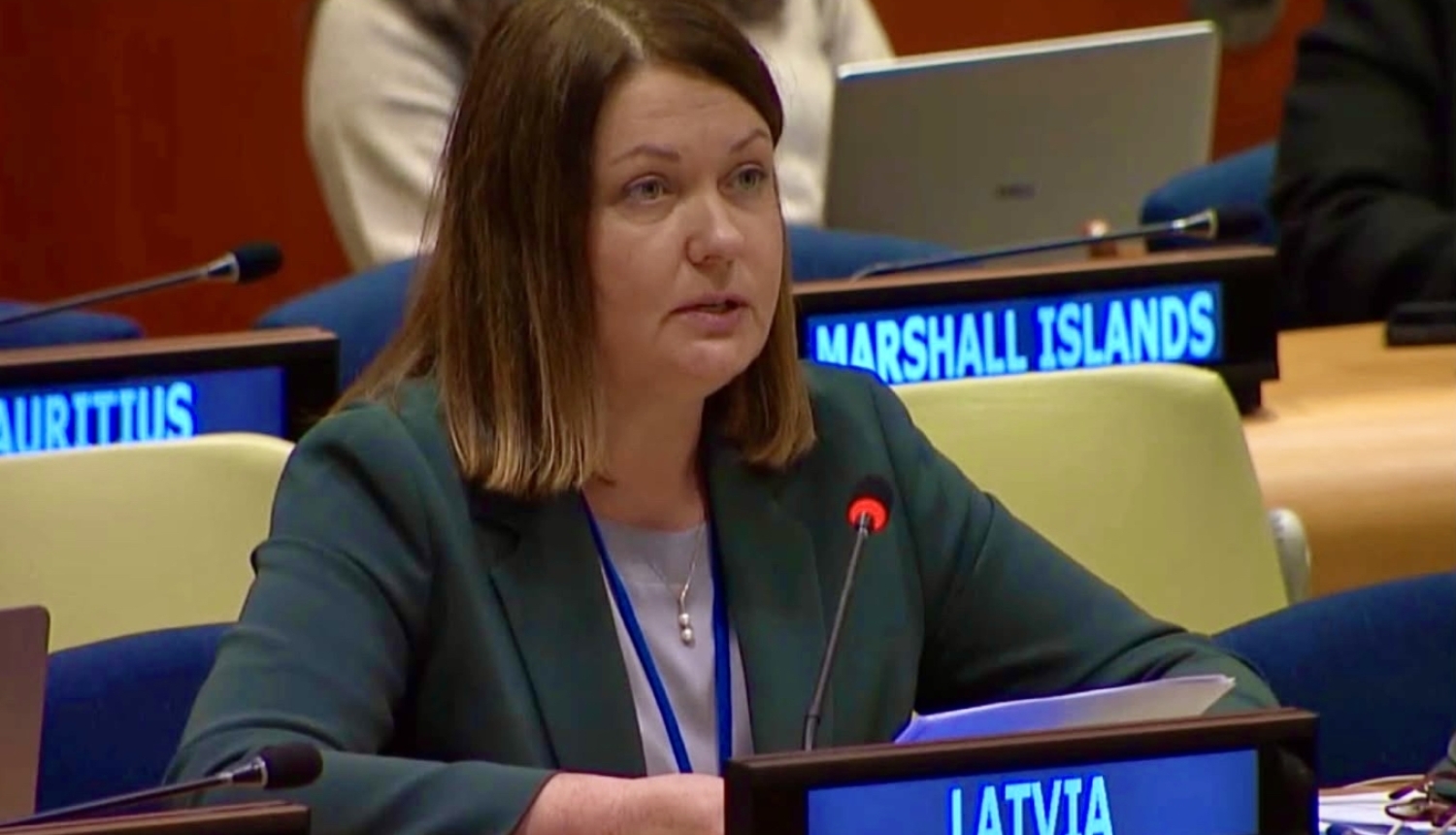
I have the honour to speak on behalf of the three Baltic States – Estonia, Lithuania and my own country Latvia. We align ourselves with the statement delivered on behalf of the European Union.
As coastal States bordering the Baltic Sea, we view sea-level rise as an important issue that requires special attention particularly with regard to legal certainty, maritime governance, human security and the resilience of coastal communities.
We welcome the adoption of the UN Declaration on Sea Level Rise and strongly advocate for promoting its objectives. The Declaration recognizes sea-level rise as an accelerating global challenge requiring strengthened international cooperation. It affirms the importance of implementing international law, including the law of the sea as reflected in UNCLOS, in responding to the consequences of sea-level rise.
In this regard, I would like to share a few reflections on the key pillars of the Declaration.
Firstly, knowledge, data and science.
Sound policymaking and legal responses must be grounded in the best available scientific knowledge. We emphasize the importance of continued cooperation among States, scientific institutions and international organizations in monitoring and understanding the impacts of sea-level rise on coastlines, ecosystems and societies.
In the Baltic Sea region, scientific cooperation has long been essential to understanding changes in the marine environment. Strengthening scientific capabilities and knowledge-sharing will remain critical for informed decision-making and effective adaptation strategies.
Secondly, the Baltic States attach particular importance to the legal dimensions of sea-level rise.
We appreciate the work of the ILC, ITLOS, and ICJ and recognise that UNCLOS remains the cornerstone of international maritime governance and rule of law at sea. To maintain its integrity, we must be consistent in its application and firm in upholding a rules-based maritime order. We commend Small Island Developing States for their leadership and tireless efforts in advancing international discussions on sea-level rise and its implications under international law. Their contribution has been instrumental.
While the Baltic region is not exposed to the same existential risks faced by low-lying coastal and small island developing States, we recognize that the legal questions raised by sea-level rise are of common concern to the international community as a whole.
We emphasize that legal stability, certainty and predictability are key principles for the maintenance of the international legal order. In the context of sea-level rise, these principles are particularly relevant with regard to maritime zones, maritime boundaries and the exercise of rights and jurisdiction under international law. The Baltic States believe that there is no legal obligation to update baselines, geographical coordinates or outer limits of maritime zones once they are properly established under the law of the sea in case of sea-level rise.
Finally, as Baltic coastal States, we have a strong interest in ensuring stable maritime governance.
Legal certainty supports navigation, sustainable management of marine resources, marine scientific research, offshore renewable energy development, and the protection of critical underwater infrastructure. It is therefore essential that responses to sea-level rise reinforce, rather than weaken, the predictability and stability upon which peaceful maritime cooperation depends.
Estonia, Lithuania and Latvia align with the presumption of the continuity of statehood and the maintenance of international legal personality in the case of states whose land surface may be totally or partially submerged or rendered uninhabitable by rising sea levels. We need to preserve legal stability, certainty and predictability as well as security in international relations. The disappearance of one typical constituent element – territory – should not necessarily lead to the loss of statehood; a position shared also by the International Court of Justice in its Advisory Opinion.
[Chair,]
The Baltic States welcome the international consensus reflected in the UN Declaration on Sea Level Rise. We reaffirm our commitment to international law, multilateral cooperation and evidence-based decision-making in addressing the challenges posed by sea-level rise.
We stand in solidarity with those States and communities most affected by sea-level rise and remain committed to supporting efforts within the United Nations to preserve legal certainty and ensure that international law continues to provide effective responses to this global challenge.
Thank you.