
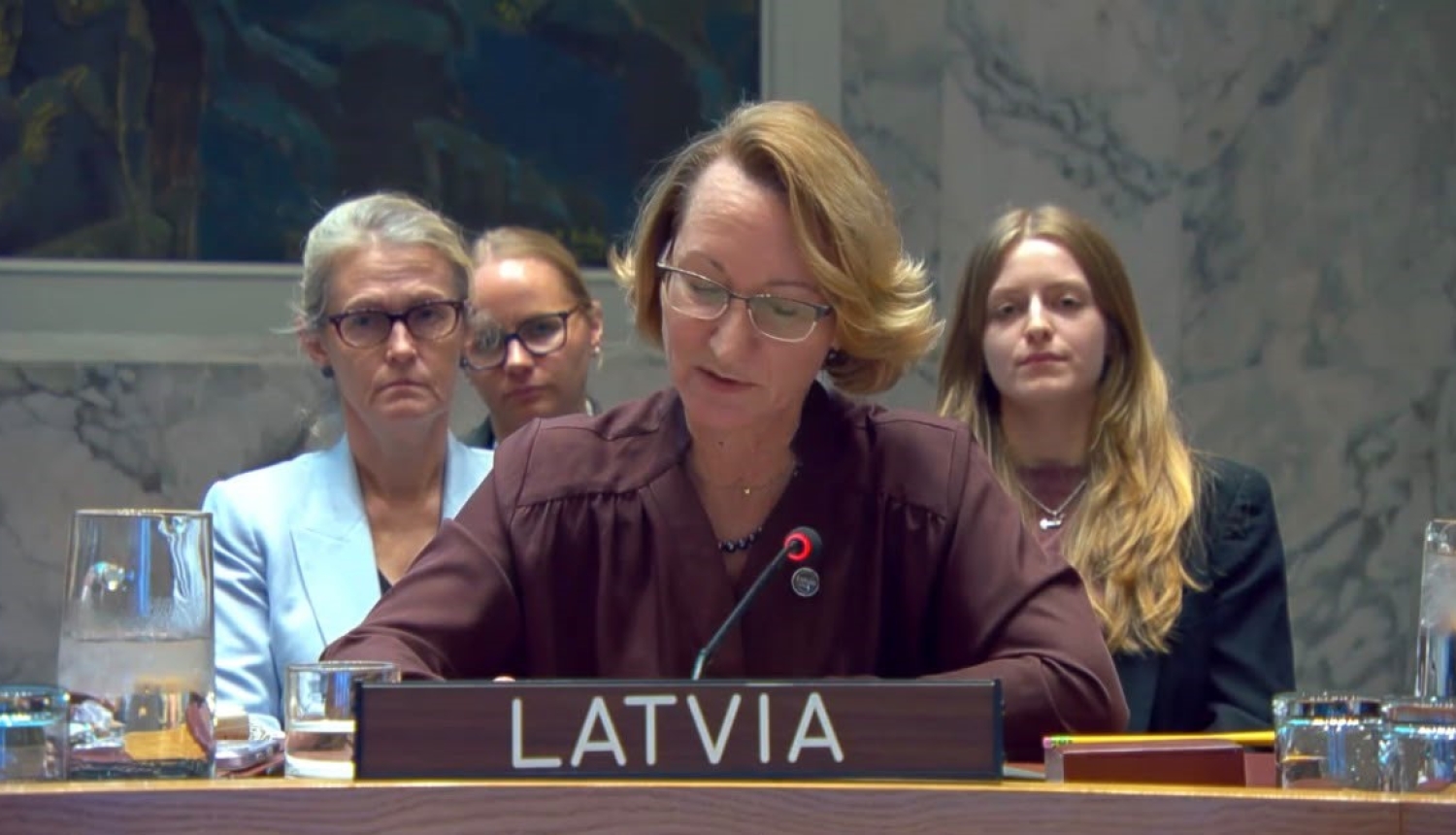
Thank you, Mr President,
I would like to once again thank H.E. Giorgos Gerapetritis, Minister of Foreign Affairs of the Hellenic Republic, who is presiding over this meeting.
I thank the UN Secretary-General, Antonio Guterres, for his annual report, and dedication to advancing the Women, Peace and Security agenda throughout his tenure.
I also thank Executive Director of UN Women, Sima Bahous and Tamana Zaryab Paryani for their powerful insights and tireless efforts to turn the WPS agenda into action.
Mr President,
We are witnessing a dangerous regression.
Women continue to be excluded from decision making. Those who speak out face growing threats and reprisals.
And resistance to gender equality is intensifying in conflict settings.
As our briefers noted, women’s participation in formal peace negotiations is declining, while their representation in political governance remains severely constrained.
The human consequences are devastating.
In Yemen and Iraq, women in public life face violence, sometimes with fatal consequences.
In Ukraine, women delivering humanitarian assistance risk their lives every day to support communities devastated by Russia’s war of aggression.
We remember Ukrainian journalist Victoria Roshchina, who died in Russian custody.
Her body was returned bearing evidence of horrific abuse and mutilation.
In Herat, Afghanistan, Taliban authorities continue to detain and intimidate dozens of women and girls simply for exercising their fundamental right to exit in public spaces.
Across conflict settings, women in public life, including human rights defenders, politicians, journalists, face psychological warfare, systemic harassment, and physical violence intended to silence them.
And conflict-related sexual violence continues to be deliberately used as a weapon of war.
Mr. President,
Latvia knows that protecting women in conflict requires more than declarations.
Together with women’s civil society organization Centre MARTA, the Latvian government has established 3 psychological support centres in Ukraine.
They provide support for women and girls, subjected to rape, torture, abuse, forced displacement from their homes, separation from their loved ones – as a result of Russia’s barbaric war.
This is what the Women, Peace and Security agenda looks like in practice – turning solidarity into tangible support for women whose lives have been shattered by war.
And we pay our respects and utmost admiration for the hundreds of thousands of brave Ukrainian women.
Serving on the front line and in the rear, in hospitals, command posts, logistics hubs, and back at home. All defending their country.
And basic principles of international law.
Mr President,
Lasting peace cannot be achieved without the participation of women.
According to research by Oxford University, when women and civil society networks are included in negotiations, peace agreements are 64% less likely to fail.
Latvia’s own experience demonstrates the value of women’s leadership in security and defence.
Women serve in senior command positions of our National Armed Forces.
Colonel Antoņina Bļodone, who has commanded the Latvian National Armed Forces Headquarters Battalion, is an example of women’s leadership in national security.
We are proud to have women actively participating in the National Guard, the reserve forces, cyberforces.
Their participation goes beyond representation. It strengthens our institutions and brings broader perspectives to security decisions.
Mr President,
We must therefore uphold zero tolerance for violence and reprisals, demand strict accountability for perpetrators.
And actively dismantle the harmful gender norms that perpetuate exclusion.
These imperatives are at the heart of Latvia’s upcoming National Action Plan on WPS.
Building on our experience, we are focusing on three concreate areas of action.
First, strengthening women’s participation and leadership in the security sector. Latvia has established a Gender Advisor position within its defence sector and integrated gender perspectives into military training and international operations.
Second, preventing and responding to gender-based violence.
For example, we have introduced specialized training for justice and law enforcement professionals on victim protection.
Third, turning national experience into international action. Latvia supports women’s participation in international missions promoted WPS agenda through cooperation with partner countries, particularly in Ukraine.
Mr President,
These realities require keeping the WPS agenda at the very core of this Council’s mandate.
Latvia advocates for dedicated Gender and Women’s Protection Advisers across all UN missions.
WPS must also remain a priority across the entire international system, from conflict prevention and climate action to the UN80 reform process.
And the next UN Secretary-General must champion women’s full, equal, meaningful, and safe participation across all pillars of the UN.
For more than eighty years, no woman has served as Secretary-General.
It is time to change that.
Mr President,
It is time to move beyond speaking about women.
It is time to ensure that women themselves have their rightful seat at the table.
I thank you.