
Mister President,
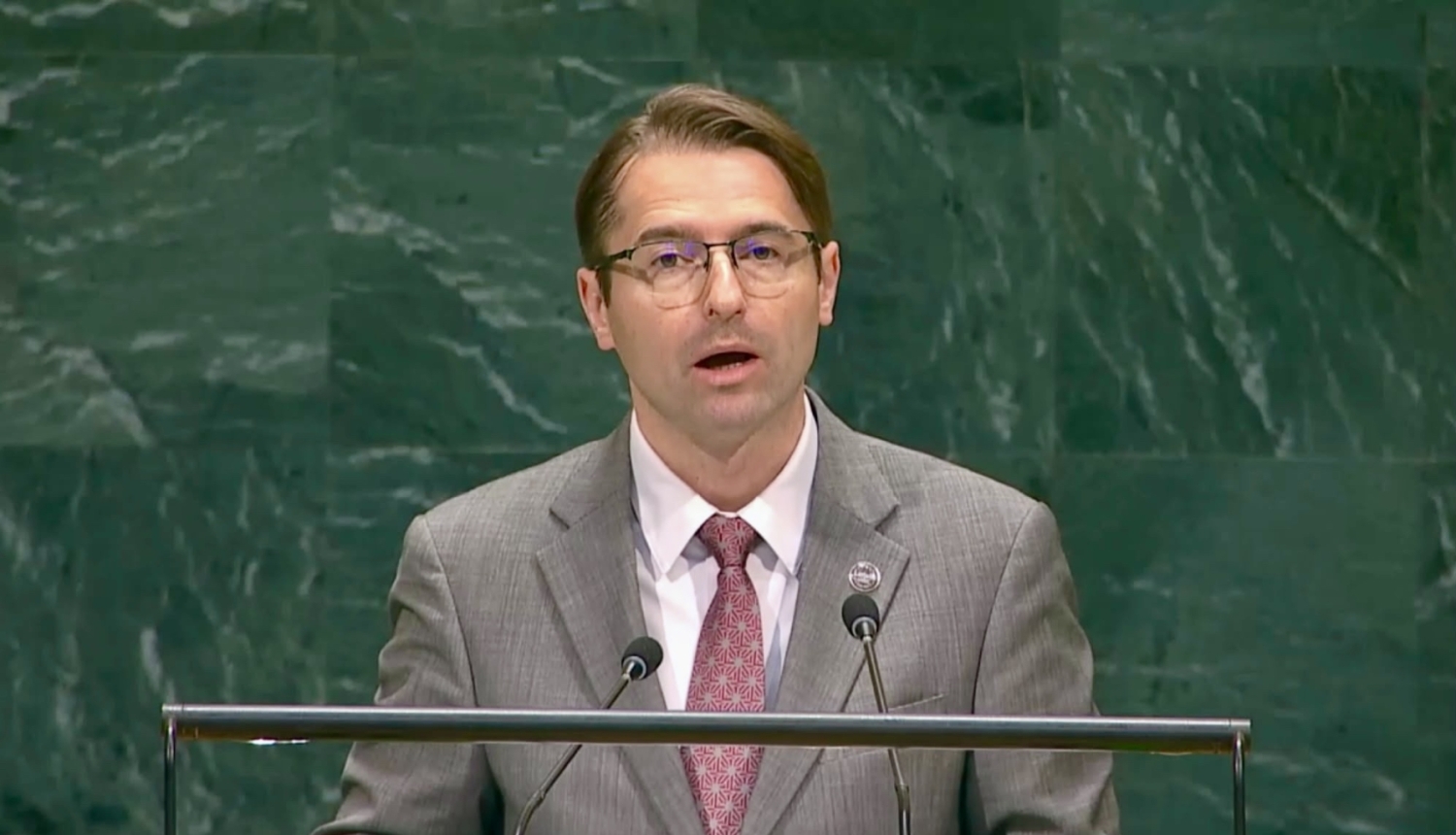
I have the honour to speak on behalf of the three Baltic States – Estonia, Lithuania and my own country Latvia. We align ourselves with the statement delivered by the European Union and the cross regional statement delivered by Liechtenstein.
The United Nations Charter entrusted the Security Council with the primary responsibility of the maintenance of international peace and security. This responsibility entails an obligation to act in accordance with the purposes and principles of the Charter.
Yet, too often, the use of the veto has prevented the Council from fulfilling its mandate, including in the face of grave violations of international law and threats to international peace and security.
Particularly unacceptable is when a permanent member responsible for the breaches of international law invokes the veto to evade accountability for their own misconduct. For the Baltic States, this is not an abstract concern: Russia continues to wage its illegal war of aggression against Ukraine, while exploiting its permanent seat on the Security Council to prevent meaningful Council action. The veto must never be used for violations of the very Charter that the Security Council is entrusted to uphold.
We wish to make three points.
Firstly, every use of the veto must be subject to greater accountability and transparency.
The adoption of General Assembly resolution 76/262, known as the Veto Initiative, was an important step towards strengthening accountability within the United Nations. It established a mechanism requiring the permanent members to explain and justify their use of the veto before the wider UN membership. However, transparency alone cannot prevent the misuse of the veto or address its consequences .
We support strengthening the practice of preparing informal summaries of General Assembly debates on the use of the veto, including concrete recommendations and proposals for further action.
Secondly, Security Council paralysis must not result in paralysis of the United Nations as a whole.
While the Security Council bears primary responsibility for international peace and security, this responsibility is not exclusive. The General Assembly has an important complementary role under the Charter, particularly when the Council is unable to act.
We must use all tools available to the General Assembly, to ensure that the Security Council inaction does not impede the wider membership from responding to threats to international peace and security. We believe that if particular action is essential for the performance of the UN General Assembly’s duties, as for example action for maintenance of international peace and security, then there is an assumption that it has competence to act.
Thirdly, the use of the veto must be exercised responsibly and with restraint.
The Baltic States remain committed to the ACT Code of Conduct and support the French-Mexican initiative on veto restraint in situations involving mass atrocities. We urge all Member States, particularly the permanent members of the Security Council, to support these commitments.
The use of the veto to undermine the effectiveness of the Security Council sanctions regimes is also a matter of serious concern. Panels of Experts are a vital instrument for the comprehensive implementation and oversight of the Council mandated sanctions. They play a particularly important role in identifying efforts to circumvent sanctions and recommending necessary changes to sanctions regimes. Effective sanctions require credible, independent monitoring and access to reliable information. Undermining these mechanisms weakens implementation and the Council's ability to uphold its own decisions.
Finally, we reiterate the importance of Article 27, paragraph 3, of the UN Charter, which requires a party to a dispute to abstain from voting on decisions under Chapter 6. This is not an optional political commitment, but a binding obligation under the Charter. Its full and consistent implementation is essential to preserving the integrity, credibility and effectiveness of the Council's decision-making.
Mr. President,
The veto is part of the Security Council's decision-making system. It was never intended to place any Member State above the principles, purposes and obligations of the UN Charter. Permanent membership carries special responsibilities for the maintenance of the international peace and security, not immunity from accountability.
I thank you.