
 Flickr
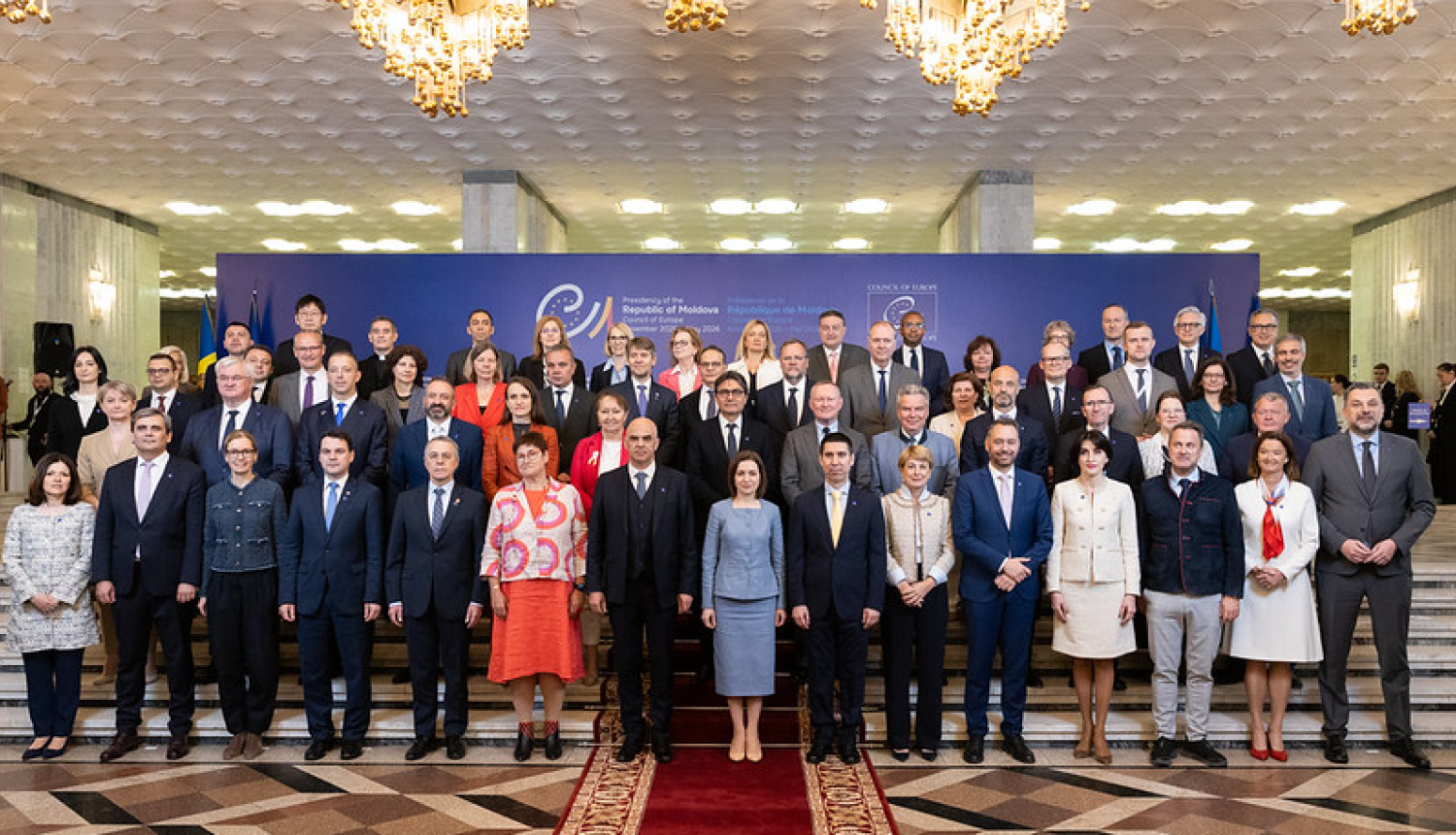
On 14–15 May 2026, in Chișinău, the Republic of Moldova, the Parliamentary Secretary of the Ministry of Foreign Affairs, Artjoms Uršuļskis, participated in the 135th annual Ministerial Session of the Council of Europe Member States.
The Ministerial Session approved the Resolution on the establishment of the Enlarged Partial Agreement on the Management Committee of the Special Tribunal for the Crime of Aggression against Ukraine. In total, 34 Council of Europe Member States, as well as the European Union, Australia, and Costa Rica, have expressed their intention to join the Enlarged Partial Agreement on the Management Committee of the Special Tribunal for the Crime of Aggression against Ukraine and have submitted notifications to the Secretariat of the Council of Europe regarding their intention to join.
During the session, the Parliamentary Secretary reaffirmed Latvia’s firm commitment to continue advocating for the Council of Europe’s core values: democracy, the rule of law, and respect for human rights, which form the foundation of security, stability, and cohesion across Europe.
Artjoms Uršuļskis highlighted Latvia’s considerable efforts in support of Ukraine. Latvia strongly supports the establishment of the Special Tribunal for the Crime of Aggression against Ukraine, as well as the work of the Register of Damage and the International Claims Commission. Latvia is among the first Member States to have ratified the Convention on the Establishment of the International Claims Commission. This is a clear demonstration of the determination to ensure international accountability for the crime of aggression.
Council of Europe Member States also discussed the challenges posed by migration in Europe, and a political declaration on migration was adopted. The declaration strengthens the political unity of European countries by fostering a shared understanding of the challenges posed by migration, hybrid threats, and the instrumentalisation of migrants. A unified political stance significantly enhances Europe’s collective resilience.
During the discussion, Artjoms Uršuļskis emphasised that Latvia’s eastern border is subject to constant migration pressure caused by the instrumentalisation of migrants by the Belarusian regime, with the support by Russia. Latvia continues to act in full compliance with fundamental human rights and security, and is investing significant resources to ensure the protection of the EU’s external borders.
Artjoms Uršuļskis noted the initiative and expertise of Moldova’s Presidency, drawing attention to the issue of foreign information manipulation and interference. Member States support the need for the Council of Europe to continue its work on developing common standards for combating foreign information manipulation and interference.
Alain Berset, Secretary General of the Council of Europe, presented a report on the initiated strategic and political process “Towards A New Democratic Pact for Europe”, launched in 2025 to address the erosion of democracy and strengthen democracy in Europe.
Latvia reaffirms its readiness to actively engage in the Council of Europe’s New Democratic Pact for Europe cooperation process in order to strengthen the resilience of democracy, the rule of law, and respect for human rights as essential foundations of European stability. The New Democratic Pact is an important tool that will help Member States adapt to modern challenges, ranging from hybrid threats to strengthening public trust in democratic institutions.
The heads of the delegations of the European Union Member States met with the President of the Republic of Moldova, Maja Sandu, to discuss the progress of reforms in Moldova and the EU accession negotiation process. The head of the Latvian delegation also met with Valeriu Chiveri, Deputy Prime Minister for Reintegration of Moldova, to exchange views on developments in Moldova’s Transnistria region and the government’s efforts towards Moldova’s reintegration.
Background information
The Council of Europe was founded in 1949 and is the oldest political organisation in Europe, bringing together 46 European countries. The aim of the organisation is to build a common democratic and legal space, ensuring respect for and protection of its core values: human rights, democracy, and the rule of law.