
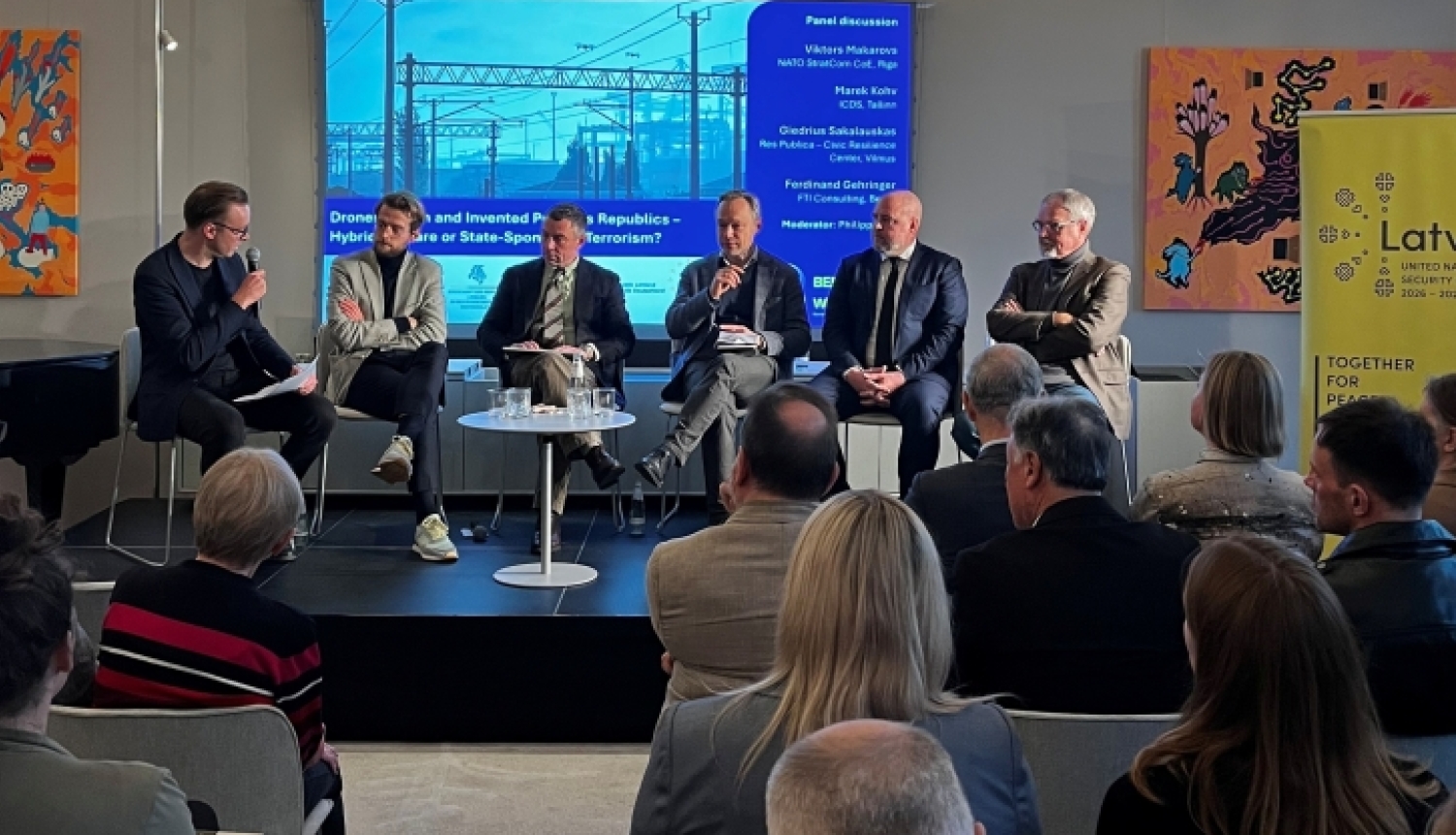
On 9 November 2026, the Embassy of Latvia in Germany, Berlin, co-organised a well-attended panel discussion on the Baltic states’ experience in strengthening societal resilience and identifying cyber-attacks and disinformation which provided an opportunity to share their experience and knowledge on cyber security with German experts.
Particular attention was paid to distinguishing between hybrid threats, sabotage, foreign influence operations and other destabilising activities targeting critical infrastructure, democratic institutions and public trust in government.
Latvia was represented at the event by Viktors Makarovs, an expert at the NATO Strategic Communications Centre of Excellence. The insights provided on Russia’s disinformation and cyberattack campaigns in Europe were well received by the audience. The escalation of hybrid threats posed by Russia is increasingly affecting Germany as well, highlighting the need to strengthen cooperation between state institutions, the private sector and the public on security issues.
During the discussion, the experts had the opportunity to exchange views on common security challenges, highlighting the practical expertise of the Baltic states. During the panel discussion, Viktors Makarovs emphasised that information integrity and the security of cyberspace must be safeguarded at both government and societal levels. Attendees showed particular interest in the role of artificial intelligence in cyber security.
Experts on societal resilience and cybersecurity from Estonia, Lithuania and Germany also participated in the discussion. Estonia was represented by researcher Marek Kohv; Germany by political scientist Dr Raphael Bossong and security adviser Ferdinand Gehringer; and Lithuania by Giedrius Sakalauskas, Director of the Center Res Publika.
The event was organised by the Embassy of Latvia in Germany in cooperation with the Embassies of Estonia and Lithuania and the German-Baltic Future Foundation (Deutsch-Baltische Zukunftsstiftung).
The event was organised as part of the diplomatic programme to support the implementation of Latvia’s priorities during its membership in the UN Security Council and to promote Latvia’s recognition. On 1 January 2026, Latvia began its term on the UN Security Council. In November 2026, Latvia assumed the presidency of the UN Security Council for the first time in history. Serving as a non-permanent member of the Security Council is an important tool for ensuring Latvia’s foreign policy interests. The overarching aim of this membership is to strengthen Latvia’s security, including by supporting Ukraine and protecting the rules-based international order.