
 Flickr
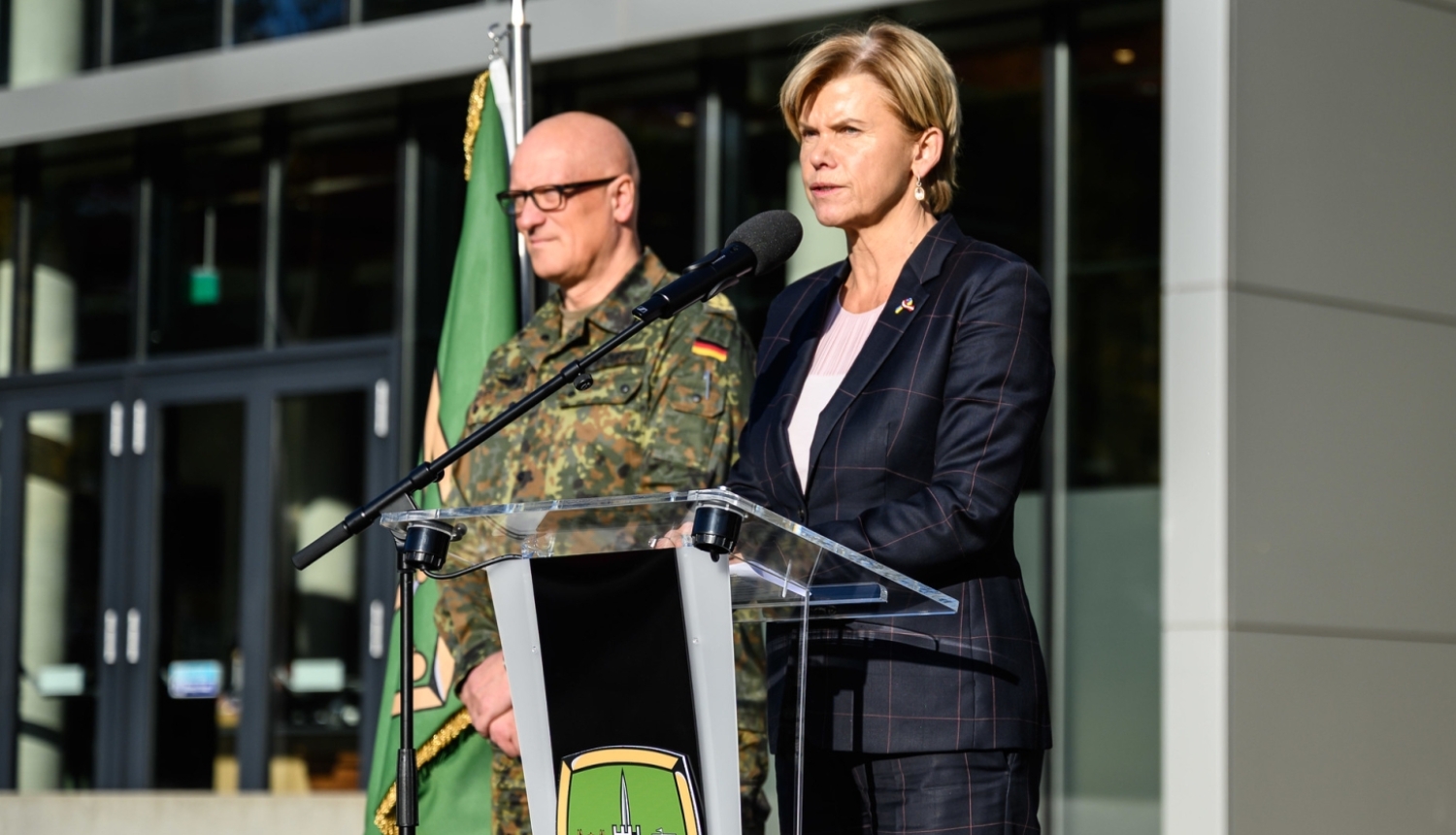
On 4 November 2026, during her working visit to the Netherlands, Minister for Foreign Affairs Baiba Braže visited NATO’s Allied Joint Force Command Brunssum and participated in an informal meeting of foreign ministers. Discussions focused on NATO’s eastern flank, the strengthening of Latvia’s eastern border and air defence, continued support for Ukraine, and increasing pressure on Russia. Officials also discussed the security situation in the Middle East and transatlantic cooperation.
At NATO’s Allied Joint Force Command Brunssum, the Minister met with its Commander, General Ingo Gerhartz, to discuss the development of NATO’s deterrence and defence capabilities, as well as further efforts to strengthen NATO’s eastern flank. In particular, Baiba Braže emphasised the need to strengthen Latvia’s eastern border and boost air defence capabilities. The Minister also confirmed Latvia’s readiness to host more allied troops and offered favourable conditions for the testing of new military technologies.
The Minister expressed her gratitude for the Netherlands’ contribution to the security of NATO’s eastern flank, the assumption by the German–Netherlands Corps (1GNC) of tactical command of NATO land forces in Latvia and Estonia, and for the role played by the US and Canada in strengthening the security of the Baltic states. The parties also exchanged views on the development of NATO’s combat capabilities and the Alliance’s resilience in the face of Russia’s threats.
During the visit, the Minister participated in an informal meeting of foreign ministers organised by Tom Berendsen, Minister of Foreign Affairs of the Netherlands, and Dr Johann Wadephul, Federal Minister for Foreign Affairs of Germany.
During the meeting, the officials discussed Russia’s war of aggression against Ukraine, developments in the Middle East and transatlantic relations. The Minister emphasised the need to continue providing comprehensive support to Ukraine, in particular by strengthening the resilience of Ukraine’s energy sector and its air defence ahead of the coming winter. The Minister called for continued international pressure on Russia by expanding sanctions and preventing Russia’s participation in international sporting and cultural events.
Discussions on the situation in the Middle East focused in particular on international efforts to effectively resolve the situation in the Strait of Hormuz, as well as on the next steps towards ending the conflict in Gaza. The Minister emphasised support for a peaceful two-state solution to the Israeli–Palestinian conflict.
The ministers discussed current issues in the transatlantic dialogue, including the role of the United States in European security and the new EU–Canada strategic partnership framework. The Minister noted that the United States and close transatlantic cooperation remain an indispensable foundation for European security.