
 Flickr
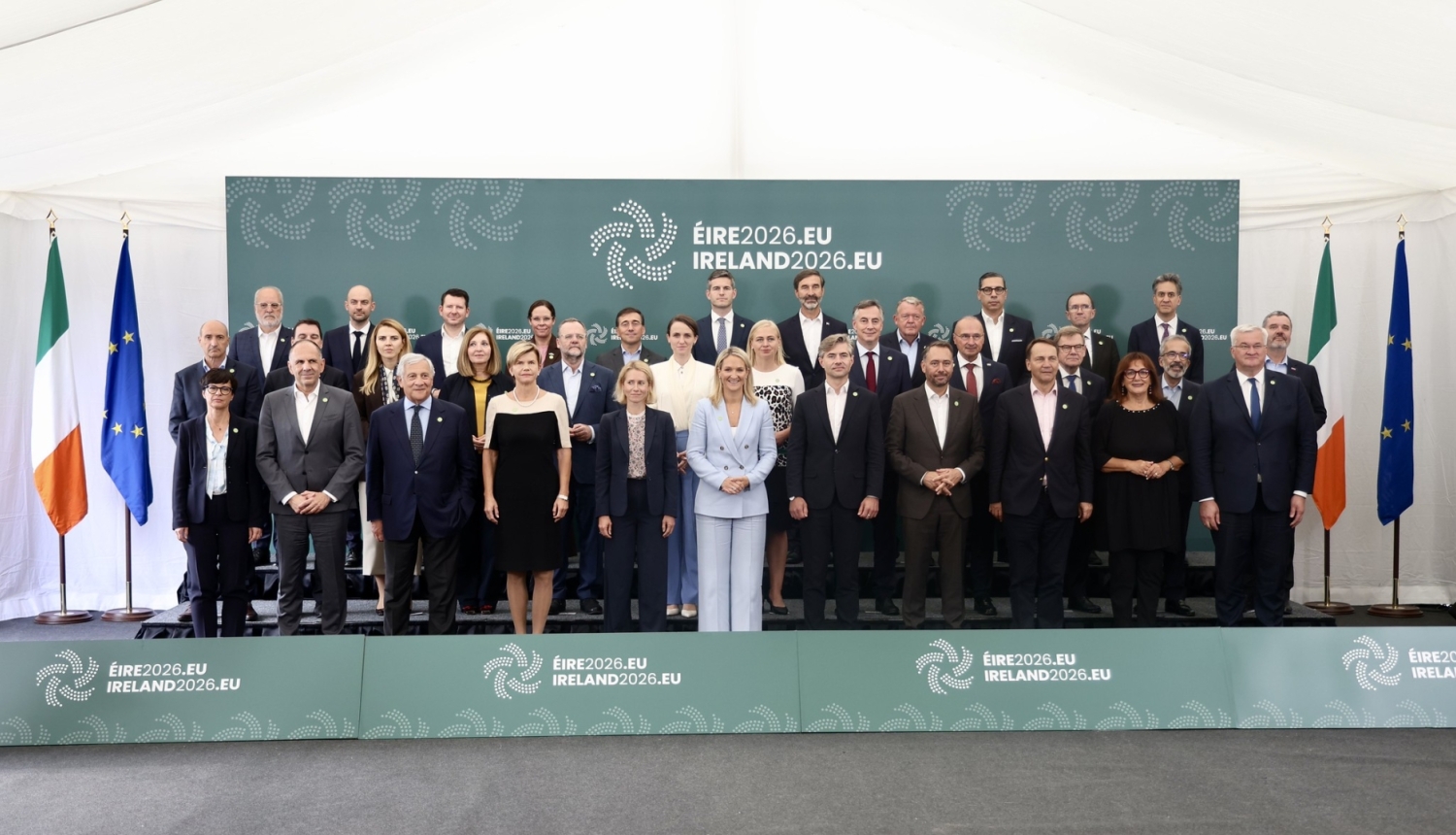
On 1 and 2 September 2026 in Wicklow, Ireland, the Minister of Foreign Affairs, Baiba Braže, participated in the informal meeting of EU foreign ministers, known as Gymnich, where she emphasised that the threat posed by Russia to Europe, including the attempted drone attack on Leipzig Airport, constitutes state-sponsored terrorism. At the meeting, the Minister discussed support for Ukraine, the situation in the Middle East and the strengthening of the EU's external action, and agreed with Canada's Minister of Foreign Affairs, Anita Anand, to cooperate closely and share information in the search for missing nationals in Nepal.
The informal meeting of EU foreign ministers was also attended by representatives from Canada, Iceland, Norway, Switzerland, and the United Kingdom, as well as Ukraine's Minister of Foreign Affairs, Andrii Sybiha. During a meeting with the Canadian Foreign Minister, Baiba Braže agreed on cooperation between the two countries in Nepal – 33 Latvian nationals are missing in Nepal, while the approximate number of missing Canadian nationals is 30. Both countries have sent representatives to Nepal. The ministers agreed to cooperate closely and exchange information should any news emerge regarding their missing nationals.
One of the central issues at the Gymnich meetings was Russia's aggression in Ukraine and the threat it poses to Europe. The meeting took place the day after Germany held Russia responsible for an attempted attack by an armed drone at Leipzig Airport. Baiba Braže expressed Latvia's full solidarity with Germany's Minister of Foreign Affairs, Johann Wadephul, and the German public. “The attack in Leipzig confirms once again that Russia poses a direct threat to the security of all of Europe. This was not merely a hybrid attack, but state-sponsored terrorism on German soil,” the Minister emphasised.
At the same time, she reminded the participants of Russia's systematic attacks on Ukraine and its civilians. July this year was the deadliest month for Ukrainian civilians since 2022. The Minister called for continued efforts to strengthen Ukraine's defence capabilities, economic and societal resilience, and its energy infrastructure.
Baiba Braže encouraged limiting Russia's ability to produce missiles, drones and other weapons by regularly imposing new sanctions, in addition to the planned sanctions packages the adoption process of which tends to be slow. At the same time, the EU must also continue to advance the 22nd sanctions package and extend the existing sanctions against Russia and Belarus.
Discussing the situation in the Middle East, the Minister reaffirmed Latvia's support for a diplomatic solution to the conflict with Iran and for the restoration of freedom of navigation in the Strait of Hormuz. The ministers also discussed the humanitarian situation in Gaza, the escalation of violence in the West Bank, the prospects for a two-state solution, and the situation in Lebanon.
EU foreign ministers also discussed ways to make the EU's external action more effective and responsive, strengthen cooperation with international partners, and increase the EU's influence in multilateral forums.
Prior to the foreign ministers' meeting, on 1 September, the Minister also met in Dublin with the Chairman of the Irish Parliament's Committee on Foreign Affairs and Trade, John Lahart, and committee members Ken O'Flynn and Alice-Mary Higgins to discuss the priorities of the Irish Presidency of the Council of the EU, the situation in the Middle East, Russia's aggression in Ukraine, and the current security situation in the region.
Additionally, the Minister participated in an event organised by the Institute of International and European Affairs in Ireland entitled “Latvia's EU Priorities”. The Minister also met with members of the Latvian community in Ireland to discuss current events and listen to the concerns of the diaspora.