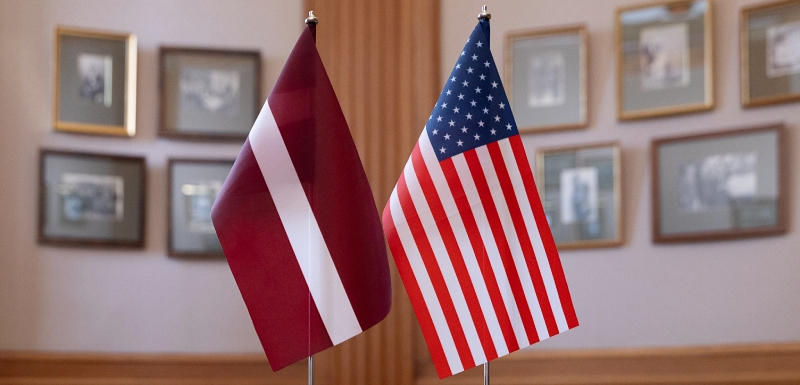
Latvijas un ASV karogi, foto: Laura Celmiņa, Ārlietu ministrija

The United States of America (United States) is Latvia’s strategic partner and ally. Security policy remains a central pillar of bilateral cooperation between Latvia and the United States. The government officials of Latvia and the United States maintain regular political dialogue on current regional and international affairs.

The United States recognised the Republic of Latvia on 28 July 1922. Before Latvia regained independence in 1991, the United States pursued a consistent policy of non-recognition of the occupation of Latvia, made an invaluable contribution to the restoration of Latvia’s independence, and promoted Latvia’s integration into NATO and the EU.

Latvia’s diplomatic representation in the United States

The Embassy of Latvia is located in Washington.

Elita Kuzma has been the Ambassador Extraordinary and Plenipotentiary of the Republic of Latvia to the United States since 18 September 2024.  

There are twenty Honorary Consuls of Latvia in the United States: 

  • Southern California: Juris Bunkis;
  • South Carolina, Greenville: Roberts Jānis Kukainis;
  • Georgia, Atlanta: Kevin Casebier;
  • Southeast Florida and Atlantic Coast: Barry Donald Mowell;
  • Southwest Florida and Gulf Coast: Eric Eduard Kalnins;
  • Illinois: Robert Blumberg;
  • Indiana State: Andris Peter Berzins;
  • Utah, Salt Lake City: Jeffrey Kent Scott;
  • Colorado: Aivars Ziedins;
  • Louisiana: Walter Francis Wolf;
  • Massachusetts: Uldis Kārlis Sīpols;
  • Michigan: Andris Lacis;
  • Michigan State: Karlis Steinmanis;
  • New York State: Ahmet M. Oren;
  • Oregon: Uldis Berzins;
  • Pennsylvania State, Philadelphia: John J. Medveckis;
  • Texas, Houston: Peter Aloizs Ragauss;
  • Washington State: Imanta Frederick Holmquist;
  • Vermont: Daris Gunars Delins;
  • Northern California: Laura Irene Ramanis.

Diplomatic representation of the United States in Latvia

The United States Embassy is located in Riga.

Melissa Argyros has been the Ambassador Extraordinary and Plenipotentiary to the Republic of Latvia since 20 February 2026.

Latvia and the United States during the interwar period

On 28 July 1922, the Government of the United States issued a statement recognising the Government of Latvia, and diplomatic relations between the two countries were subsequently established. In 1922, the Latvian legation was opened in Washington, but in May 1923, it temporarily transferred its functions to the consulate in New York. In 1925, the Latvian legation in Washington, resumed its activities, but due to a lack of funds, it was closed in 1927, with its functions being taken over by the Consulate General of Latvia in New York. The legation resumed its activities in 1935.

The United States legation in Riga was opened on 13 November 1922.

Between 1919 and 1922, the American Relief Organisation and American non-governmental organisations were active in Latvia, providing significant support to the Latvian people during the early stages of state formation.

Riga was visited by several prominent Americans in the late 1930s, former President of the United States, Herbert Hoover, (March 1938) and future President of the United States, John Kennedy, (August 1939) among them. George Kennan, a prominent expert on Russian affairs in the United States Department of State, worked in Riga as an American diplomat in the first half of the 1930s.

During the interwar period, a treaty of friendship, trade, and consular rights was signed between Latvia and the United States.

Policy of the United States during the occupation of Latvia

Diplomatic relations between Latvia and the United States were destined to play a unique role in the entire history of Latvia’s foreign service. The declaration of 23 July 1940 by acting US Secretary of State Sumner Welles established a policy of non-recognition of the occupation of the Baltic states until 1991 and ensured the existence of Baltic representation in Washington. Thus, the United States never recognised the occupation of Latvia (or Lithuania and Estonia) and did not establish official relations with the Soviet government in occupied Latvia. The position reflected the principles of the Atlantic Charter, signed by the United States and Great Britain in 1941, which regarded territorial alterations and the deprivation of sovereignty as illegitimate if undertaken without the free consent of the peoples involved, and also mirrored the 1947 Truman Doctrine, which did not recognise forced changes in the international system. The Latvian legation in Washington was the only foreign legation of our country that continued to operate at full capacity throughout the occupation of Latvia. During the years of occupation, its principal objectives were to continue representing the Latvian state, preserve Latvia’s international legal status, advocate for the restoration of independence, and carry out vital informational work by publishing Western declarations, statements, and documents relating to Latvia, as well as providing news on the situation in occupied Latvia.

On 15 July 1940, even before any official response, the United States Treasury Department froze the bank accounts of the Baltic states; subsequently, the USSR was also unable to gain control of Latvian ships and the assets of its diplomatic missions abroad. Latvian funds, including interest on deposits held in the United States, were used throughout the occupation to support the functioning of diplomatic missions, including those in other Western countries.

On the basis of the policy refusing to recognise the occupation of the Baltic states, and in accordance with the Displaced Persons Act of 1948, Baltic refugees were allowed to settle in the United States after the war. Latvian communities in the United States expanded and became increasingly well organised. Political, cultural, and social organisations were established, which influenced political decision-making in Washington.

The Government of the United States supported the idea of Latvian independence. Latvia’s representatives in the United States enjoyed full diplomatic recognition, including access to the United States Department of State and the President, and were invited to official events. Latvia’s envoy Anatols Dinbergs met every United States President from Franklin D. Roosevelt to George H. W. Bush. In 1963, following the death in London of Kārlis Zariņš, who had been authorised by the Government of Latvia to lead Latvia’s diplomatic service abroad, this responsibility was transferred to Latvian diplomats in the United States, in accordance with a decision by the heads of Latvia’s diplomatic missions: initially to A. Spekke, and from 1971 to A. Dinbergs. During this period, funding was allocated to the Latvian, Lithuanian, and Estonian Freedom Committees in the United States. United States Presidents and members of Congress often voiced their public support for the Baltic states. In 1953, a special investigative committee of the House of Representatives was established to investigate the communist regime’s aggression against the Baltic states, known as the Kersten Committee. Over a period of two years, it conducted extensive research, and the documents prepared by the committee provided further justification for the United States policy of non-recognition.

In 1982, President Ronald Reagan declared 14 June as Baltic Freedom Day, commemorating the mass deportations in the Baltic states in 1941.

Cooperation between the Latvian representation in Washington and the United States Department of State in the late 1980s facilitated the establishment of the first unofficial contacts between Latvia and the Government of the United States. The 41st President of the United States, George (Herbert Walker) Bush, played a significant role in the restoration of the Baltic states’ independence in 1991, helping to bring the issue of their freedom to the fore in meetings with USSR President Mikhail Gorbachev and later with the President of Russia, Boris Yeltsin.

For additional information on relations between Latvia and the United States, see the book Latvia and the USA: From Captive Nation to Strategic Partner (2008).
Visits by Latvian officials to the United States
24–25 March 2025 Working visit by the Minister of Foreign Affairs, Baiba Braže, to Washington, USA, together with the Ministers of Foreign Affairs of the Baltic states; meeting with the United States Secretary of State, Marco Rubio, and members of Congress
25–26 February 2025 Working visit by the Minister of Foreign Affairs, Baiba Braže, to Washington, USA; meeting with members of the United States House of Representatives, as well as representatives of the American business community
4–7 February 2025 Working visit by the Minister of Foreign Affairs, Baiba Braže, to Washington, USA, together with the Ministers of Foreign Affairs of the Baltic states; meeting with United States officials, leading think-tanks, and media representatives
4–6 December 2024 Working visit by the Minister of Foreign Affairs, Baiba Braže, to Washington; meeting with United States officials, leading think-tanks, and media representatives
18–20 September 2024 Visit by the President of Latvia, Edgars Rinkēvičs, the Minister of Economics, Viktors Valainis, and a delegation of entrepreneurs to California, including meetings with leading technology companies of the United States, i.e. META, Google, Open AI
8–11 July 2024 Working visit by the Minister of Foreign Affairs, Baiba Braže, to Washington; participation in the Latvian delegation at the NATO 75th Anniversary Summit
25 March 2024 Working visit by the Minister of Foreign Affairs, Krišjānis Kariņš, to Washington, USA, together with the Ministers of Foreign Affairs of the Baltic states; meeting with the United States Secretary of State, Antony Blinken, and other United States officials, leading think-tanks, and media representatives
11–14 March 2024 Working visit by Prime Minister Evika Siliņa to the USA; participation in the 68th session of the UN Commission on the Status of Women in New York; meeting with UN Secretary-General António Guterres, as well as with United States officials, members of Congress, business community representatives, leading think-tanks, and representatives of the Latvian diaspora in Washington
29 January–1 February 2024 Visit by the Speaker of the Saeima, Daiga Mieriņa, to Washington, USA, together with Estonian and Lithuanian parliament leaders; meeting with the Speaker of the United States House of Representatives, Mike Johnson, and other United States Senate and House of Representatives politicians
22 September 2023 Visit by the President of Latvia, Edgars Rinkēvičs, to Boston, USA; meeting with Massachusetts Governor Maura Healey; participation in the Spotlight Latvia 2023 conference

Visits by United States officials to Latvia

29–31 August 2024 Visit by a delegation of senators and congressmen led by the United States Senator Mark Kelly; meeting with Prime Minister Evika Siliņa and the Minister of Foreign Affairs, Baiba Braže
17–18 July 2024 Visit by a delegation of the members of Congress led by Congressman Don Bacon to Latvia; meeting with the Minister of Foreign Affairs, Baiba Braže
3 July 2024 Visit by a delegation of the members of Congress led by Congressman Tom Cole to Latvia (meetings with Prime Minister Evika Siliņa and the Minister of Defence, Andris Sprūds)
9 June 2023 Visit by the United States Trade Representative, Katherine Tai, to Latvia; meetings with the Prime Minister and the Minister of Foreign Affairs
11 May 2023 Visit by Gretchen Whitmer, Governor of Michigan, USA, to Latvia; meeting with the President of Latvia and the Minister of Foreign Affairs; visit to the Camp Ādaži military base
18 January 2023 Visit by the United States Senator Steve Daines; meeting with the Minister of Foreign Affairs
9–10 August 2022 Visit by the United States Secretary of Defence, Lloyd Austin, to Latvia; meetings with the President of Latvia, Prime Minister, and the Minister of Foreign Affairs
7 March 2022 Visit by the United States Secretary of State, Antony Blinken, to Latvia; meetings with the President of Latvia, Prime Minister, and the Minister of Foreign Affairs

Other notable meetings / Meetings during international events

22 February 2023 Meeting of the President of Latvia, Egils Levits, with the President of the United States, Joe Biden, together with the leaders of the NATO’s eastern flank (B9 – Bucharest Nine) countries in Warsaw, Poland
19–20 September 2022 Meeting of the Minister of Foreign Affairs, Edgars Rinkēvičs, with the United States Deputy Secretary of State, Wendy Sherman, together with the NATO’s eastern flank (B9 – Bucharest Nine) Ministers of Foreign Affairs on 20 September and participation in the United States-Latvia Business Forum on 19 September during the UN General Assembly in New York
18 February 2022 Meeting of the President of Latvia, Egils Levits, with the Vice President of the United States, Kamala Harris, together with the Baltic states during the Munich Security Conference
14 June 2021 Meeting of the President of Latvia, Egils Levits, with the President of the United States, Joe Biden, together with the Baltic states, during the NATO Summit in Brussels

Latvia and the United States have dynamic economic relations, as evidenced by the growing interest of Latvian businesses in the US market and rising export volumes, especially in the segment of specialised, high value-added products. Latvia has foreign representative offices in Boston and San Francisco, which provide support to Latvian entrepreneurs in promoting exports, information on starting a business and opportunities to implement investment projects, as well as assistance in promoting foreign trade.

Further information

Cooperation in the field of defence is of strategic importance to Latvia, and therefore receives particular attention. The United States was the first country to launch the Atlantic Resolve training operation after Russia’s annexation of Crimea in spring 2014 and the aggression in eastern Ukraine, sending a company-level unit to Latvia. The operation aims to demonstrate the continued US contribution to the collective security of NATO members by promoting peace and stability in the Baltic states and Poland. The operation has also been deployed in Romania and Bulgaria. As part of operation Atlantic Resolve, each year a helicopter unit of the US Armed Forces arrives in Latvia, contributing to the development of capabilities and skills of the National Armed Forces of Latvia. Latvia is also regularly visited by units of the US Armed Forces, both by conducting individual exercises and by engaging in military training activities taking place in Latvia. At the end of 2022, the United States Congress approved funding in the amount of USD 225 million for 2023 as part of the Baltic Security Initiative.

27 April 2023 marked 30 years since the US State Partnership Program between Latvia and the Michigan National Guard was signed. This includes active cooperation, supporting the development of the National Armed Forces, with particular emphasis on the National Guard and the Latvian Air Force. Every year, soldiers from the National Armed Forces of Latvia take part in the Northern Strike military exercise in Michigan.

Further information

Bilateral relations between Latvia and the United States are strengthened by an active Latvian community in the United States, represented by the American Latvian Association.