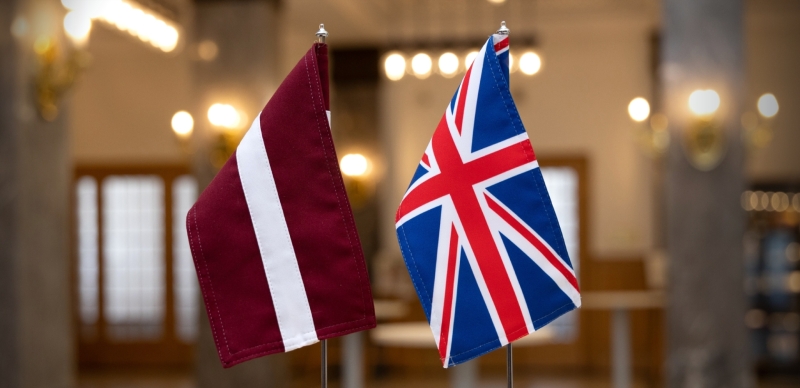
Latvijas un Apvienotās Karalistes karogi, foto: Laura Celmiņa, Ārlietu ministrija

The United Kingdom of Great Britain and Northern Ireland, or the United Kingdom, is an important cooperation partner for Latvia. Both countries share a history of friendly relations, alongside common interests and cooperation at bilateral, regional, and multilateral levels. The United Kingdom stands as a major ally of Latvia in the fields of security and defence, while also serving as a significant trading partner. Latvia’s largest diaspora, numbering over 160,000 nationals, maintains a special link with the United Kingdom.

In June 2016, citizens of the United Kingdom voted in a referendum to leave the European Union. The United Kingdom left the European Union on 31 January 2020, and a transition period was set until 31 December 2020. The EU-UK Trade and Cooperation Agreement was signed in December 2020 and entered into force on 1 May 2021. Although the United Kingdom is no longer a member of the European Union, it remains an important partner for Latvia in economic and security matters, as well as in other fields. On 6 December 2021, the Ministers of Foreign Affairs of Latvia and the United Kingdom signed a Joint Declaration of Cooperation to foster closer political dialogue, promote economic relations, and enhance cooperation in foreign and security policy.

The United Kingdom was the first country in the world to recognise the Latvian Provisional National Council as a de facto independent institution on 11 November 1918 (a week before Latvia declared independence on 18 November 1918), and the delegate Zigfrīds Anna Meierovics as the unofficial diplomatic representative of the Latvian Provisional Government in the United Kingdom.

The armed forces of the United Kingdom participated in the Latvian War of Independence in 1919. In the spring of 1919, when most of Latvia was occupied by the Bolsheviks, the steamship Saratov, anchored in the Baltic Sea near Liepāja and serving temporarily as the refuge and operational base of the Latvian Provisional Government and its leader Kārlis Ulmanis, was under the protection of British warships. This British support reinforced the image of the United Kingdom as a friendly superpower in Latvian society.

On 26 January 1921, the Supreme Council of the Allied Powers (Belgium, France, Italy, Japan, and the United Kingdom) recognised the state of Latvia de iure. On 6 May 1921, the Latvian legation was established in the United Kingdom, and Georgs Bisenieks was appointed as Latvia’s envoy.

The United Kingdom was among the countries that never recognised the occupation and incorporation of Latvia into the USSR. After the occupation of Latvia on 17 June 1940, Kārlis Zariņš, Latvia’s envoy in the United Kingdom, based on the extraordinary powers granted by the Government of the Republic of Latvia, continued to represent the interests of the state of Latvia and its citizens in Western Europe. The principled stance of the United Kingdom allowed the Latvian legation and its diplomats in London to continue their work throughout the years of occupation, thus ensuring the de iure continuity of the Republic of Latvia.

On 27 August 1991, the United Kingdom, jointly with other member countries of the European Community, recognised the restoration of independence of the Republic of Latvia. On 8 October 1991, the Ambassador of the United Kingdom, Richard Samuel, began his work in Riga. At the time when Latvia regained its independence, the Latvia’s representation in London was headed by Marie-Anne Zariņa, daughter of envoy Kārlis Zariņš. The first Ambassador Extraordinary and Plenipotentiary of the Republic of Latvia to the United Kingdom was Jānis Lūsis.

Latvia’s diplomatic representation in the United Kingdom

The Embassy of Latvia is located in London.

Atis Lots was appointed the Ambassador of Latvia to the United Kingdom on 29 August 2024.

Previous Ambassadors of Latvia to the United Kingdom of Great Britain and Northern Ireland:

  • 1993–1996 Jānis Lūsis;
  • 1997–2001 Normans Penke;
  • 2001–2002 Imants Daudišs;
  • 2002–2004 Jānis Dripe;
  • 2005–2009 Indulis Bērziņš;
  • 2009–2013 Eduards Stiprais;
  • 2013–2016 Andris Teikmanis;
  • 2016–2020 Baiba Braže;
  • 2020–2024 Ivita Burmistre.

Latvia has three Honorary Consuls in the United Kingdom:

  • since May 2015, George Stephen Gillie has been Honorary Consul with responsibility for the North East of England;
  • since May 2016, Karen Tracey has been Honorary Consul with responsibility for West Midlands;
  • since May 2016, David Kaye has been Honorary Consul with responsibility for Glasgow.

United Kingdom’s diplomatic representation in Latvia

The Embassy of the United Kingdom is located in Riga.

Katherine Jane Leach has been serving as the Ambassador of the United Kingdom to Latvia since 18 August 2025.
Visits by Latvian officials to the United Kingdom
1 December 2025 Working visit by the Minister of Foreign Affairs, Baiba Braže
17–19 July 2024 Prime Minister Evika Siliņa attends the European Political Community Summit
27–29 May 2024 Working visit by the President of Latvia, Edgars Rinkēvičs, meeting with His Majesty King Charles III
12–14 March 2024 Working visit by the Minister of Foreign Affairs, Krišjānis Kariņš
21–22 June 2023 Working visit by Prime Minister Krišjānis Kariņš
5–7 May 2023 President of Latvia, Egils Levits, attends the coronation ceremony of His Majesty King Charles III
19 September 2022 President of Latvia, Egils Levits, attends the funeral of Her Majesty Queen Elizabeth II
14–15 March 2022 Working visit by Prime Minister Krišjānis Kariņš
6–7 December 2021 Visit by the Minister of Foreign Affairs, Edgars Rinkēvičs   
10–11 July 2019 Visit by the Minister of Foreign Affairs, Edgars Rinkēvičs
15–17 March 2019 Visit by the Minister of Foreign Affairs, Edgars Rinkēvičs
18–20 July 2016 Official visit by the President of Latvia, Raimonds Vējonis
5–7 September 2014 Working visit by Prime Minister Laimdota Straujuma
16–17 October 2012 Visit by the Minister of Foreign Affairs, Edgars Rinkēvičs
26–28 October 2008 Visit by the Minister of Foreign Affairs, Māris Riekstiņš
9–13 July 2006 Visit by the President of Latvia, Vaira Vīķe-Freiberga
Visits by UK officials to Latvia
19 December 2022 Working visit by Prime Minister Rishi Sunak
30 November–1 December 2021 Foreign Secretary Elizabeth Truss meets Baltic Foreign Ministers during the Meeting of NATO Foreign Ministers
14–15 August 2018 Official visit by Foreign Secretary Jeremy Hunt 
19–20 November 2014 Visit by Foreign Secretary Philip Hammond 
18–19 October 2006 Visit by Her Majesty Queen Elizabeth II 

Good cooperation has been established between the parliaments of the two countries. During the term of the 14th Saeima, a parliamentary group for promoting cooperation with the Parliament of the United Kingdom has been formed, under the chairmanship of Antoņina Ņenaševa (Progresīvie). The main task of the cooperation group is to promote bilateral relations between Latvia and the United Kingdom. Parliamentarians engage in dialogue on a wide range of matters, including security and defence, sanctions, cooperation in the fields of economy, science, and education, countering disinformation and fake news, media freedom, and others.

The United Kingdom is an important trading partner for Latvia. It is in Latvia’s interests to ensure the broadest possible economic ties with the United Kingdom, including investment attraction, trade, and partnerships in science, start-ups, and technology. The United Kingdom is one of the most important partner countries for the export of goods. Wood and wooden articles are Latvia’s main export goods. Alongside forestry exports, trade and investment potential is being developed in high-tech sectors, notably defence, green, and smart technologies. The primary goods imported from the United Kingdom are vehicles, parts and fittings thereof.

Further information

The United Kingdom is an important European security partner and ally for Latvia. Both countries share a common understanding of the threats and challenges to European security. The United Kingdom is also a close ally within NATO.

Since Latvia regained its independence, the United Kingdom has provided significant assistance in building defence structures and developing regional cooperation among the Baltic states, as well as substantial support in the field of training. The contractual basis for relations between Latvia and the United Kingdom was established on 4 October 1994, with the signing of a memorandum of understanding on defence contacts and cooperation between the Ministry of Defence of the Republic of Latvia and the Ministry of Defence of the United Kingdom of Great Britain and Northern Ireland.

Experts from the United Kingdom work at both the NATO Strategic Communications Centre of Excellence in Riga and the NATO Force Integration Unit[1]. The United Kingdom regularly takes part in military training activities, NATO’s Baltic Air-Policing mission and, in accordance with the decision of the 2016 NATO Warsaw Summit, fulfils NATO’s Multinational Battlegroup deployment responsibilities in Estonia, thus contributing to the security of the entire Baltic region. Latvia also cooperates with the United Kingdom within the framework of the Joint Expeditionary Force[2]. Latvia’s involvement in this initiative strengthens cooperation with the United Kingdom and enables regular involvement in international military training activities, fostering practical partnerships, developing new capabilities, and enhancing interoperability among the armed forces of member countries. The cooperation between Latvia and the United Kingdom in leading the Drone Coalition[3] is also noteworthy.


[1] The NATO Force Integration Unit stationed in Latvia was established on 1 September 2015. Its main task is to facilitate the rapid and coordinated deployment of Allied forces in the region. The Unit is part of the NATO Force Structure and currently has 41 representatives from 12 NATO member countries, including Latvia as the host country.

[2] A United Kingdom initiative aimed at creating a rapid response force that is trained and equipped to respond to any type of conflict, including participation in UN, NATO, and European Union operations.

[3] On 14 February 2024, Latvia and the United Kingdom established the Drone Coalition. Its 16 member states coordinate the delivery of drones to Ukraine and work to develop allied drone capabilities.

Latvia and the United Kingdom maintain active cooperation in the fields of higher education and science. Most higher education institutions in Latvia have signed cooperation agreements with universities in the United Kingdom, thus enabling the exchange of students, academic staff, and researchers. These agreements also provide a framework for the organisation of joint scientific conferences and seminars, the publication of joint research articles, and the production of educational and methodological materials.

The British Council plays a key role in cooperation between Latvia and the United Kingdom in the field of education. It supports the organisation of courses, seminars, conferences, and teacher training programmes in Latvia. The British Council has also played a significant role in fostering cultural cooperation between Latvia and the United Kingdom. Since 1992, it has not only familiarised Latvia with British culture but has also facilitated the development of creative networks and addressed contemporary priorities in Latvian cultural policy.

There is active collaboration in cinema, music, literature, and the visual arts, as well as among theatres, museums, and national libraries.