
 Flickr
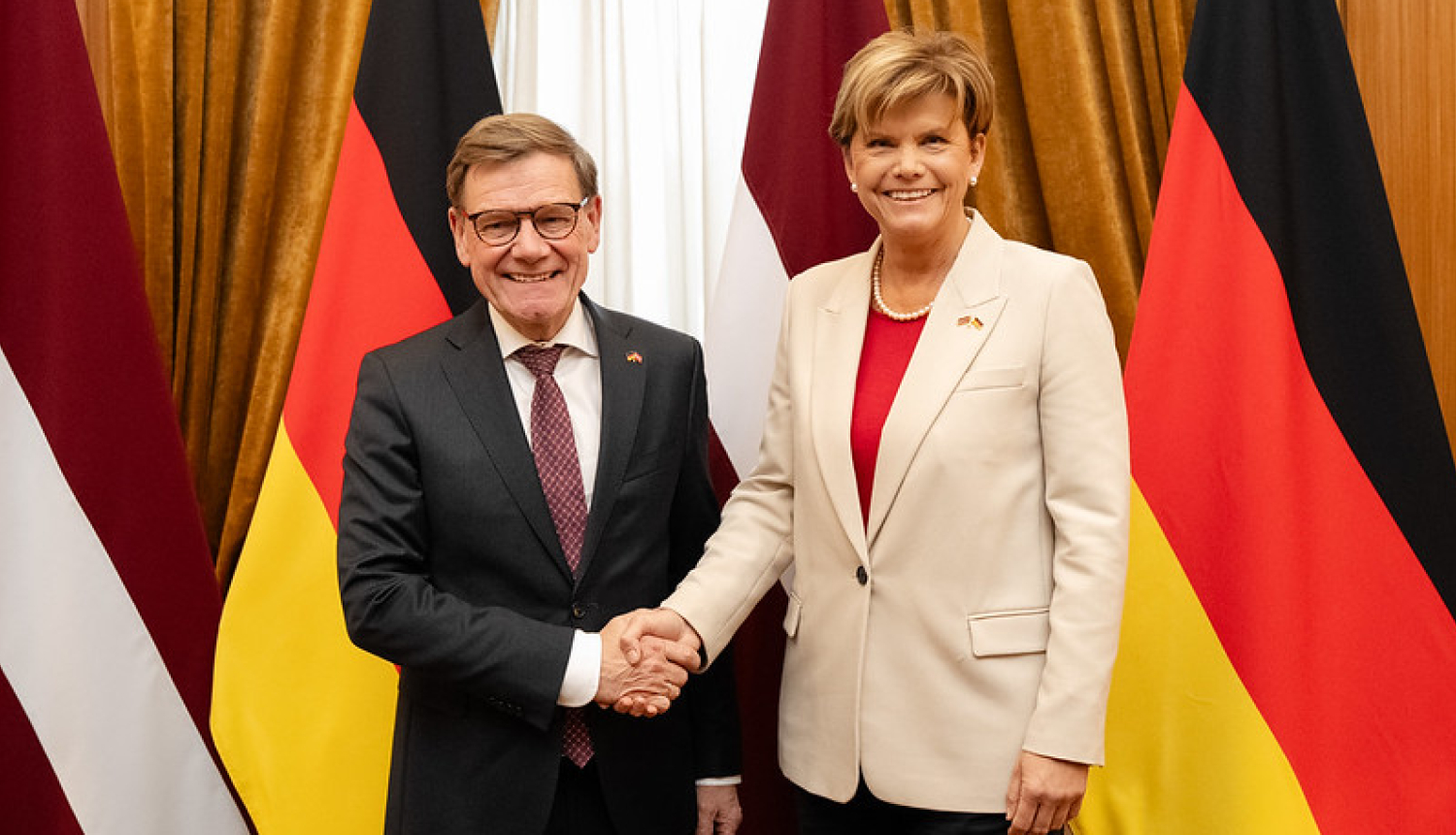
On 26 January 2026, marking 105 years since Latvia’s international (de jure) recognition, the Minister of Foreign Affairs, Baiba Braže, welcomed the Federal Minister for Foreign Affairs of the Federal Republic of Germany, Dr Johann Wadephul, during his working visit to Latvia. Ministers discussed transatlantic relations, cooperation between the EU and NATO, strengthening security in Europe, including on the eastern flank and in the Baltic Sea region, continued support for Ukraine and containment of Russia, and current EU issues – EU enlargement, EU Multiannual Financial Framework, strengthening EU competitiveness, and simplifying regulation.
Johann Wadephul addressed heads of Latvia’s diplomatic missions who are gathering in Riga this week for their annual meeting. The discussion focused on strengthening regional security and competitiveness in Europe, including by reducing bureaucracy and simplifying regulations.
Minister of Foreign Affairs, Baiba Braže:
“It is a great pleasure for Latvia to welcome my friend and colleague Johann Wadephul on such an important day. Germany is a reliable friend and a strategic ally of Latvia. We have close historical ties and excellent bilateral relations in the areas of security and economics. Our cooperation is progressing successfully at the bilateral level, as well as within the EU and NATO.
We would like to express our gratitude to Germany for its significant contribution to security in the Baltic Sea region, particularly its presence in Lithuania, regular involvement in NATO’s air policing missions in the Baltics and the Rostock command centre which also coordinates NATO’s Baltic Sentry Mission.
I am grateful for Germany’s support for Ukraine, including its USD 700 million contribution to NATO’s Prioritised Ukraine Requirements List (PURL) initiative. Our shared priority is to achieve a sustainable peace in Ukraine and to contain Russia, including by implementing targeted sanctions. We agree that Russia’s goals have not changed, so we must keep supporting Ukraine’s self-defence and increasing pressure on Russia, including through the twentieth sanctions package and measures against the shadow fleet and its ecosystem.
We agree that our transatlantic and European unity and power are our strongest asset in deterring Russia’s threats, supporting Ukraine, and securing lasting peace and security in the Euro-Atlantic area.”
Both countries seek to expand cooperation in the areas of economy, defence, energy, ICT, digitalisation, cooperation between ports, and connectivity. Cooperation in drone development and manufacturing also holds great potential. Germany ranks as Latvia’s second largest foreign trade partner and is one of the most important investors in Latvia.