
 Flickr
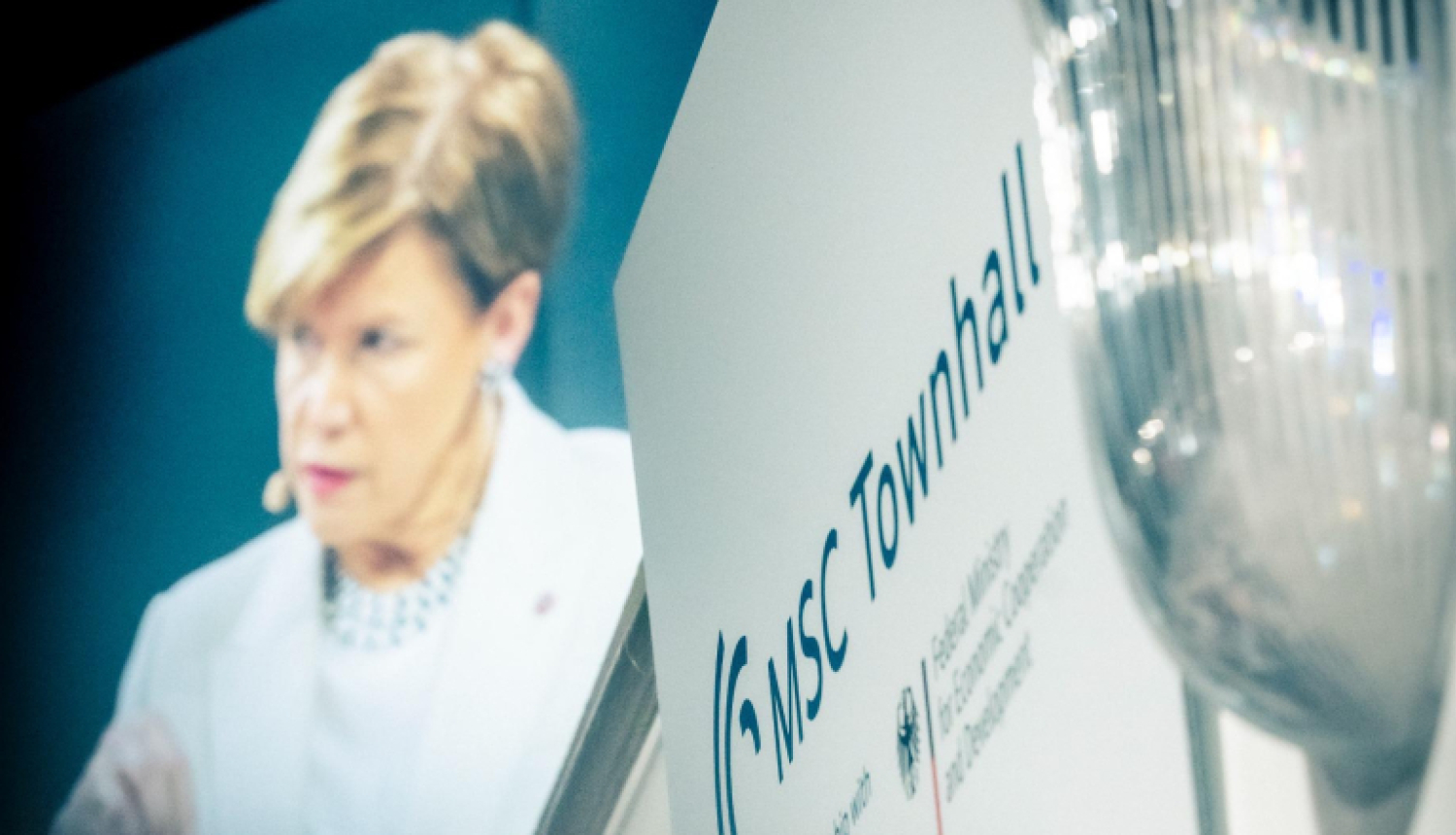
From 12 to 14 February 2026, the Minister of Foreign Affairs, Baiba Braže, attended the 62nd Munich Security Conference, where she spoke at several high-level discussions on current foreign and security policy challenges, had meetings with ministers and senior officials from Ukraine, the Baltic states, the Nordic region, and other countries.
According to Baiba Braže, the most emotional moment was meeting Ukrainian skeleton athlete Vladyslav Heraskevych. “He sends his regards and thanks for the support at the Olympic Games and for the continued support he receives day to day. He trains in Latvia and, as he said, the Latvian luge and skeleton team is his family.”
On the morning of 14 February, the United States Secretary of State, Marco Rubio, highlighted in his speech the close and unbreakable ties between the United States and Europe in terms of values, economy, and politics, and that Europe needs to continue strengthening its defence, because a strong Europe is in the interests of the United States’ national security.
This morning, a meeting took place between the Baltic and Nordic countries (NB8) and the Minister of Foreign Affairs of Ukraine, Andrii Sybiha. The Foreign Ministers discussed Ukraine’s most pressing needs for self-defence, ways to address the energy crisis caused by Russia’s terrorist actions, and measures to support the affected population. Andrii Sybiha shared information on the current progress of peace talks.
The Minister of Foreign Affairs, Baiba Braže: “Russia’s actions demonstrate no willingness to pursue peace; on the contrary, its aggression takes the lives of innocent civilians, including children, every day.
Allies within the Alliance have recognised Russia as the most significant threat to Euro-Atlantic security. Russia is waging a hybrid war across Europe. All Allies must be prepared to defend themselves against these threats by investing more in their own and collective defence. By the next NATO Summit in Ankara, all Allies must demonstrate progress towards investing 5% of their GDP in defence.
Contrary to Russian propaganda, its economy keeps collapsing, battlefield losses are immense, and the success on the battlefield is scarce. Ukraine’s Allies are stronger both militarily and economically. This needs to be acknowledged. Allies must provide maximum support for Ukraine’s self-defence, the resolution of the energy crisis, and assistance to civilians. Russia, in turn, must continue to be “forced into peace through force”, including by implementing sanctions, taking action against the shadow fleet, etc.”
Baiba Braže opened a high-level discussion on nuclear deterrence in Europe organised by the Chairman of the Munich Security Conference, Wolfgang Ischinger. She emphasised that European Allies must invest rapidly in conventional deterrence capabilities while continuing to strengthen their strategic partnership with the United States.
The Minister jointly with the Federal Minister for Foreign Affairs of the Federal Republic of Germany, Dr Johann Wadephul, participated in a discussion on the European security architecture, spoke at the European Defence Townhall discussion, and also took part in the Ditchley Foundation discussion on Russia’s sub-conventional attacks across Europe.
On the first day of the conference, Baiba Braže opened a discussion on technology and cyber policy with the National Cyber Director of the United States, Sean Cairncross, and representatives of leading technology industry companies.
The Minister held bilateral meetings with the European Union’s Sanctions Envoy, David O’Sullivan, the President of the NATO Parliamentary Assembly, Marcos Perestrello, the President of the International Criminal Court, Judge Tomoko Akane, and Deputy Minister of Veterans Affairs of Ukraine, Oleg Shymanskyi, the United States Ambassador to NATO, Matthew G. Whitaker, the United States Ambassador to the United Nations, Michael Waltz, the Minister of Foreign Affairs of the Principality of Liechtenstein, Sabine Monauni, the Minister of Foreign Affairs of the Kingdom of Bahrain, Abdullatif bin Rashid Al Zayani, the Minister of Foreign Affairs of the Republic of Maldives, Dr Abdulla Khaleel, and others.