
 Flickr
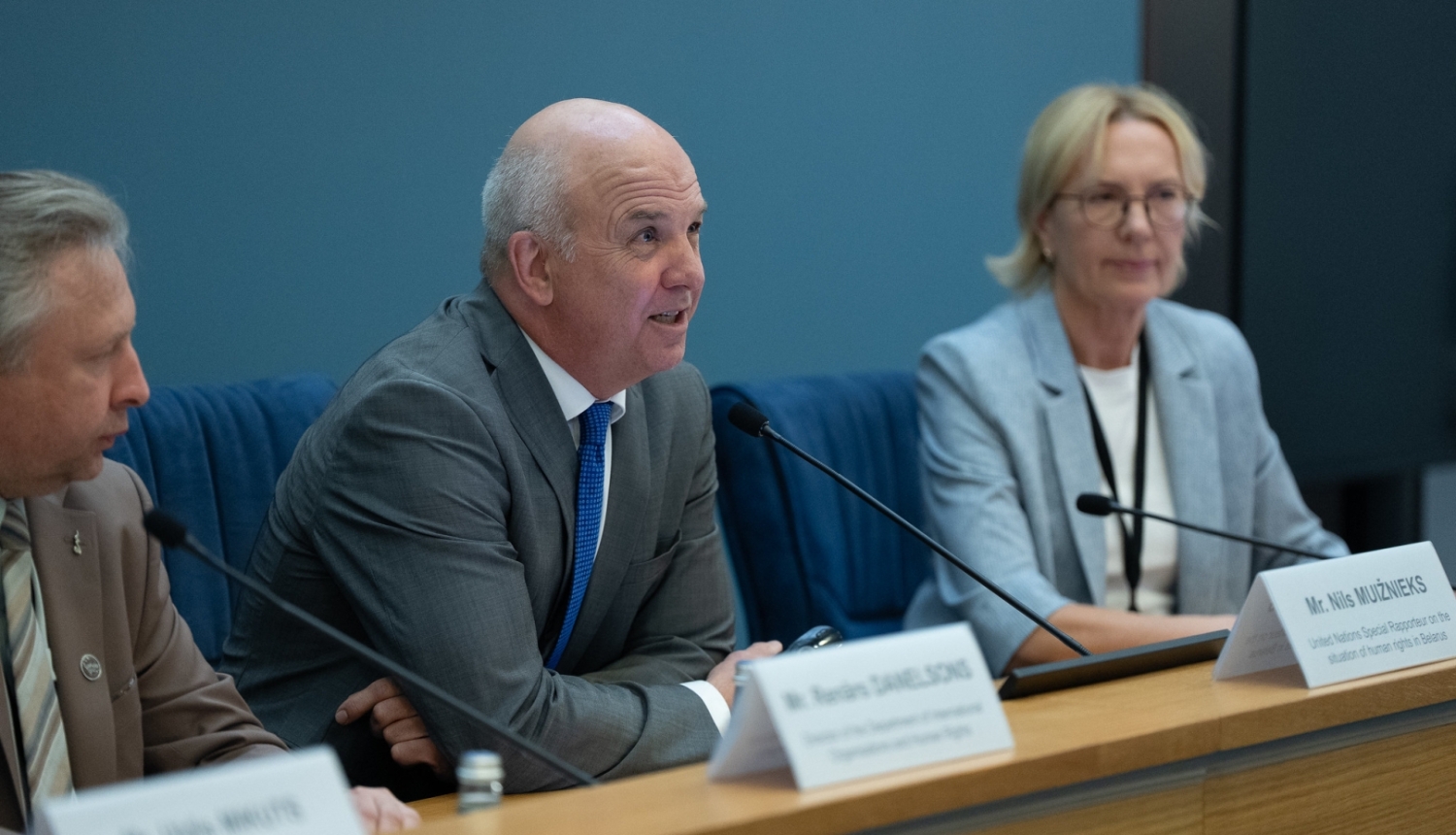
On 19 June 2026, the UN Special Rapporteur on the situation of human rights in Belarus, Nils Muižnieks, presented his latest report to the UN Human Rights Council to representatives of foreign embassies accredited in Latvia.
In the report, the Special Rapporteur concluded the following:
- Belarus continues to systematically and grossly violate human rights. Despite the recent releases of political prisoners, politically motivated repression continues. The latest wave of repression is directed specifically at supporters of Ukraine. Cross-border repression is intensifying, with the Belarusian authorities conducting trials in absentia against exiled activists and confiscating their property within the country.
- The authorities continue to misuse anti-terrorism and anti-extremism legislation to persecute opposition figures, human rights defenders, journalists and activists, including those working in the fields of culture and academia.
- Freedom of assembly and association are virtually non-existent. Since 2020, more than 3,000 civic associations, labour unions, political parties, foundations, non-governmental organisations and associations have been closed or forcibly dissolved.
- As Belarus’s political and economic dependence on Russia grows, so does the influence of Russian culture and language in Belarus. In the realm of culture, state policy is pro-Russian and explicitly anti-Western and anti-Ukrainian.
- Repression of culture workers, censorship, the labelling of works of art and actors as “extremist” and the persecution of independent book publishers and distributors continue. As of March this year, at least 148 culture workers, including 32 writers, were imprisoned or subject to restrictions, and 330 books were banned.
- The use of Belarusian language is increasingly restricted and viewed as a sign of political disloyalty. The Russian language dominates in public administration, education, the media and everyday life.
- Only 3 of 3,044 legal acts (0.1%) have been published in Belarusian.
- In education, curricula are aligned with Russian curricula, thereby further reducing the teaching of Belarusian at all levels of education.
- In 2025, 1 of 6 state television channels and 1 of 4 national radio stations were broadcasting in Belarusian. Most of the content, including culture programmes, was in Russian.
- State regulatory authorities are stepping up control over publications issued in Belarusian. In 2024, these accounted for 12.5% of all publications, while those published in Russian accounted for 80.9%.
- The education system has shifted to a comprehensive model of ideological and military-patriotic education. Schools have introduced military-patriotic education coordinators, established state-controlled military-patriotic clubs, and developed close cooperation with security forces. Militarised events and simulations are becoming increasingly common, even at the preschool level. Education is increasingly being used to instil state ideology and prepare young people for work in the security apparatus.
- Persecution for the use of historical national symbols and attempts to reshape historical memory are part of a broader policy aimed at controlling the expression of cultural and national identity.
Background information
Report of the UN Special Rapporteur on the situation of human rights in Belarus
The presentation of the report and the discussion can be followed online on the UN Television website. The discussion will begin on 29 June at approximately 16.00 Latvian time.
The UN Human Rights Council established the mandate of the Special Rapporteur on the situation of human rights in Belarus in 2012. Nils Muižnieks has held this position since 2024.
The Special Rapporteur’s mandate is to monitor the situation of human rights in Belarus and provide recommendations to strengthen the observance and protection of human rights, consult with all relevant stakeholders, including civil society, both in Belarus and abroad, and to report to the UN Human Rights Council and the UN General Assembly.