
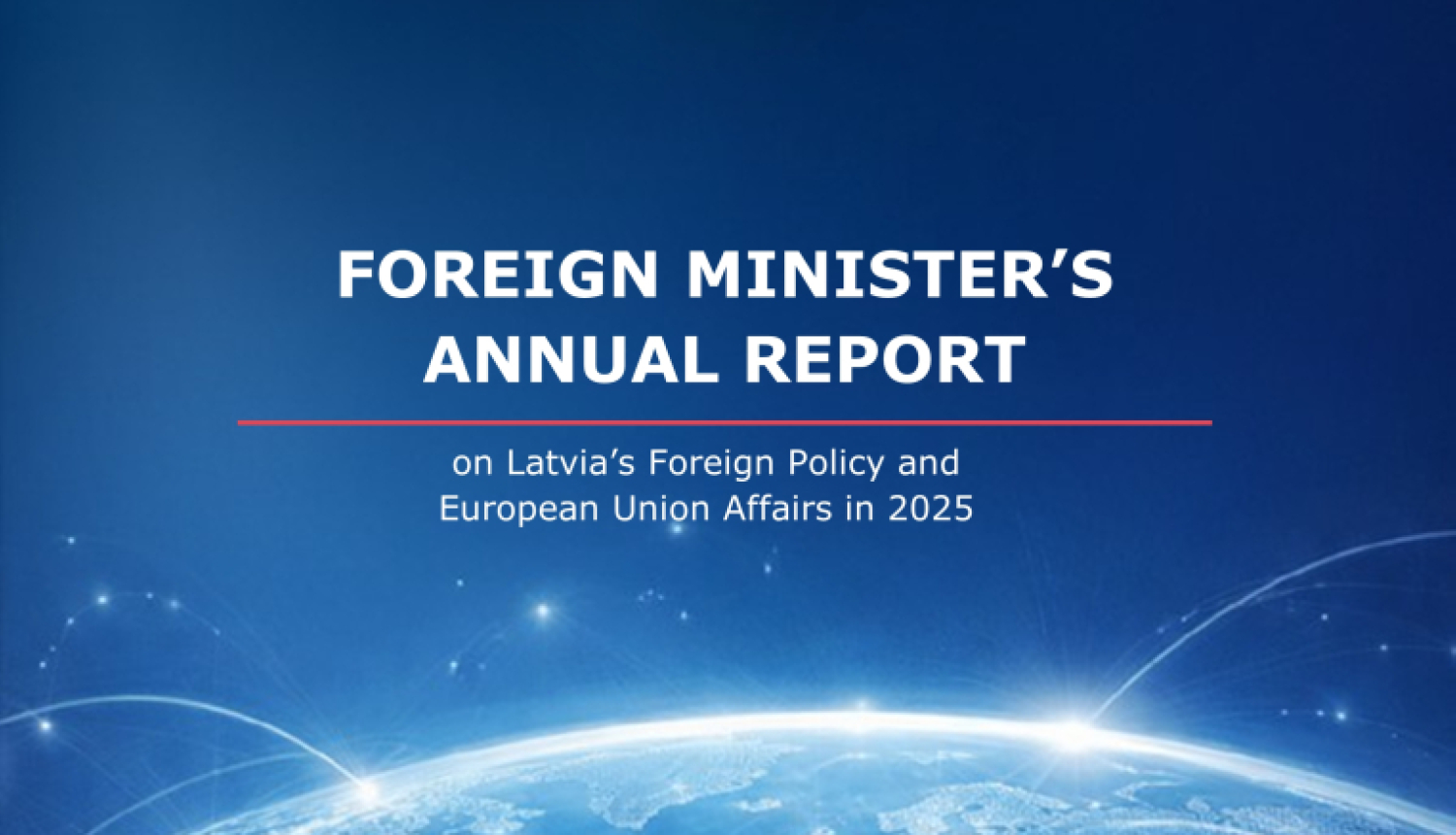
On Tuesday, 13 January 2026, the Cabinet of Ministers reviewed the report submitted by the Minister of Foreign Affairs, Baiba Braže, on the accomplishments in the field of foreign affairs in 2025 and the intended actions in Latvia’s foreign policy and European Union (EU) affairs in 2026. Latvia’s foreign policy is unified, and is consistently implemented in close coordination with the President, the Saeima, the Prime Minister, ministries, municipalities, social partners, including civil society, business, and academia.
The Foreign Minister’s Annual Report is the main foreign policy planning document, outlining the previous year’s accomplishments and setting out the key tasks for the year ahead. The annual debate on the foreign policy report at the Saeima will take place on 29 January.
Minister of Foreign Affairs Baiba Braže:
“Russia is a long-term threat to Euro-Atlantic security, international order, and global stability. It will continue efforts to divide the EU and NATO, as well as to weaken the global influence of the United States. There are no indications of Russia’s willingness to pursue peace; therefore, we will continue to apply maximum pressure on Russia in order to achieve “peace through strength”, in particular by means of sanctions.
Latvia is not under direct military threat, but we must continue to strengthen our security, the presence of NATO allied troops and deterrence missions, support Ukraine’s self-defence capabilities, and contain Russia. We must increase Latvia’s international influence, including through access to the global platform of the UN Security Council. This week, on 12 January, we convened an emergency meeting, condemned Russia’s barbaric attacks on Ukraine, including the use of ballistic missiles, and refuted the aggressor’s disinformation. We will persist in doing so.”
Last year in New York, we witnessed a historic vote as for the first time Latvia was elected to the UN Security Council with a convincing majority. Meanwhile, at the NATO Summit in The Hague, a historic agreement was reached to invest 5% of Member States’ GDP in defence. In cooperation with allies in the Baltic and Nordic countries (NB8), NATO, the EU, and other like-minded partners around the world, Latvia’s foreign policy in 2025 pursued purposeful and coordinated actions in three strategic areas: (1) strengthening national security and defence, and the rules-based international order; (2) promoting economic growth and prosperity, EU competitiveness and global influence; and (3) protecting the interests of Latvian nationals by engaging society more purposefully in the development and implementation of foreign policy, and by harnessing the potential of the diaspora.
SECURITY. Latvia’s security is based on increased domestic investment in defence, a strengthened NATO presence, and close cooperation with NATO, EU Member States, and partners worldwide.
- We continue to be leaders among NATO member countries, allocating 3.78% of GDP to defence in 2025 and 4.9% of GDP this year. The Canadian-led NATO Multinational Brigade in Latvia expanded and strengthened its combat capabilities. Last year, Canada decided to extend the Canadian Armed Forces’ presence in Latvia until 2029. The military presence of the United States, Canada, and other allied countries in Latvia currently numbers around 4000 soldiers. NATO’s presence in our region has been significantly expanded with the launch of the Baltic Defence Line and the East Shield initiative in response to Russia’s violations of NATO countries’ airspace and damage to critical undersea infrastructure.
- Through coordinated efforts at both national and Baltic levels, funding for the Baltic Security Initiative has been incorporated in the 2026 US National Defense Authorization Act. Latvia will continue to strengthen cooperation with its strategic ally, the United States, in the fields of security, defence, energy, and modern technologies.
- Latvia provides both military and non-military support to Ukraine, and since the start of the war, total support to Ukraine has reached nearly EUR 1 billion. Last year, under a bilateral agreement with Ukraine, Latvia provided military support worth around EUR 120 million, equivalent to 0.30% of GDP, including the supply of PATRIA armoured vehicles, the training of soldiers, and the supply of drones manufactured in Latvia. This year – at least 0.25% of GDP.
- Last year, the national defence industry was developed in a targeted manner, which was also facilitated by the Drone Coalition led in cooperation with the United Kingdom. Latvia is taking part in the EC Defence Readiness 2030 Roadmap, using the new financing instrument (SAFE) to strengthen defence capabilities – Latvia has submitted a funding application for EUR 3.497 billion.
- The sanctions are effective and are adversely affecting the Russian economy. For example, at the end of 2025, inflation remained at around 6% and the federal budget deficit exceeded USD 53 billion. Oil and gas revenues fell by more than 30% last year. Russia has lost at least USD 159 billion in oil export revenues. The effective application of sanctions is also a matter of security, and Latvia serves as an example to other EU Member States in the effective implementation of sanctions. Latvia is one of the few EU countries that has submitted proposals for each round of EU sanctions. Last year, sanctions were imposed on 485 shadow fleet vessels. In November, Latvia urged that sanctions be applied to these vessels without delay, rather than waiting for the next round of EU sanctions, and this practice came into effect in December.
- We continue to identify undesirable individuals who pose a threat to national security, denying them entry into Latvia and restricting their movement within the Schengen area. The Latvian government also approved regulations regarding a national sanctions regime in response to Russia’s military aggression against Ukraine.
- Latvia is one of the countries actively helping to establish a Special Tribunal for the Crime of Aggression against Ukraine. Latvia’s interests have been successfully represented in international proceedings, including in the ECHR case of Rodina and Borisova v. Latvia concerning the ban on holding events in 2014 for security reasons.
- We will continue our work to isolate Russia and Belarus in international organisations. Last year, Russia was not elected to the executive bodies of at least 10 organisations, including the International Civil Aviation Organization, the Organisation for the Prohibition of Chemical Weapons, and the International Maritime Organization.
ECONOMY. During times of global turmoil, Latvia’s growth and development depend on the ability of entrepreneurs to diversify export markets and offer innovative solutions in both traditional and new markets.
- The Ministry of Foreign Affairs actively supported exporting entrepreneurs by addressing problematic situations and establishing business contacts. In the first nine months of last year, Latvia’s exports of goods and services grew by 5.6%.
- With the involvement of the Investment and Development Agency of Latvia (LIAA), 26 new investment projects worth EUR 873 million were launched in Latvia in 2025, with support also provided by the Ministry of Foreign Affairs. The priority is to attract investment to the defence industry. Foreign investors have rated Latvia as the most attractive investment environment in the Baltics, with half indicating plans to continue investing in Latvia. By implementing 33 major projects, we are the leading Baltic country in attracting foreign investment.
- Turmoil in international trade has prompted the EU and other countries to step up their work on bilateral and regional trade agreements. The Ministry of Foreign Affairs lobbied for more favourable trade conditions for key export sectors, including the timber industry, leading to a significant reduction in customs duties applied by the United States.
- Latvia supported the signing of the EU-Mercosur agreement, as it will create the world’s largest free trade area, covering nearly a quarter of global GDP and creating a market of more than 700 million consumers in the EU and Brazil, Argentina, Paraguay, and Uruguay with great economic potential.
- Strengthened leadership in quantum technology – Latvia is involved in the creation of the world’s first quantum internet in the EU and is also the first Baltic country to establish a national quantum-secure communication network. The Ministry of Foreign Affairs supported closer cooperation between the University of Latvia and Riga Technical University with leading quantum research institutions in the region and worldwide. The world’s largest quantum conference, QIP 2026, will take place in Rīga from 24 January to 30 January.
- Latvia’s priorities for the next EU multiannual budget (2028–2034) are security and defence, cohesion, the Common Agricultural Policy, and funding for Rail Baltica.
LATVIAN PEOPLE. The consular service provided assistance to Latvian nationals in a wide range of crisis situations. In June, we assisted 42 nationals and their family members to leave Israel safely on special flights organised by other EU countries. Thanks to the support of the United States, we managed to bring back five Latvian nationals from Belarus.
- Since October 2025, a new Consular Register has been available to make it easier for travellers to register their trips abroad and for the consular service to respond more effectively in crisis situations. Last year, Latvian diplomatic missions abroad collected around EUR 7.3 million for consular services, including 14 visits with mobile passport stations.
- As part of a data-based diaspora policy, a study, Diaspora Investments in Latvia, was conducted last year in cooperation with the University of Latvia. The diaspora attracts EUR 0.94–1.0 billion to Latvia each year.
- More than one fifth of Latvian citizens live abroad, either temporarily or permanently, while around 10 000 nationals return to Latvia each year. Cooperation with and support for the Latvian diaspora, alongside measures to support remigration, will remain a key focus in the work of the Ministry of Foreign Affairs.
While preparing the report, the Minister of Foreign Affairs met with foreign policy experts, researchers, youth organisations, the non-governmental sector, and also representatives of the business community, and listened to the opinions and recommendations of the public on past achievements and future priorities in foreign policy. B. Braže presented the report and listened to the proposals of the members of the Saeima at the Foreign Affairs Committee and the European Affairs Committee.