
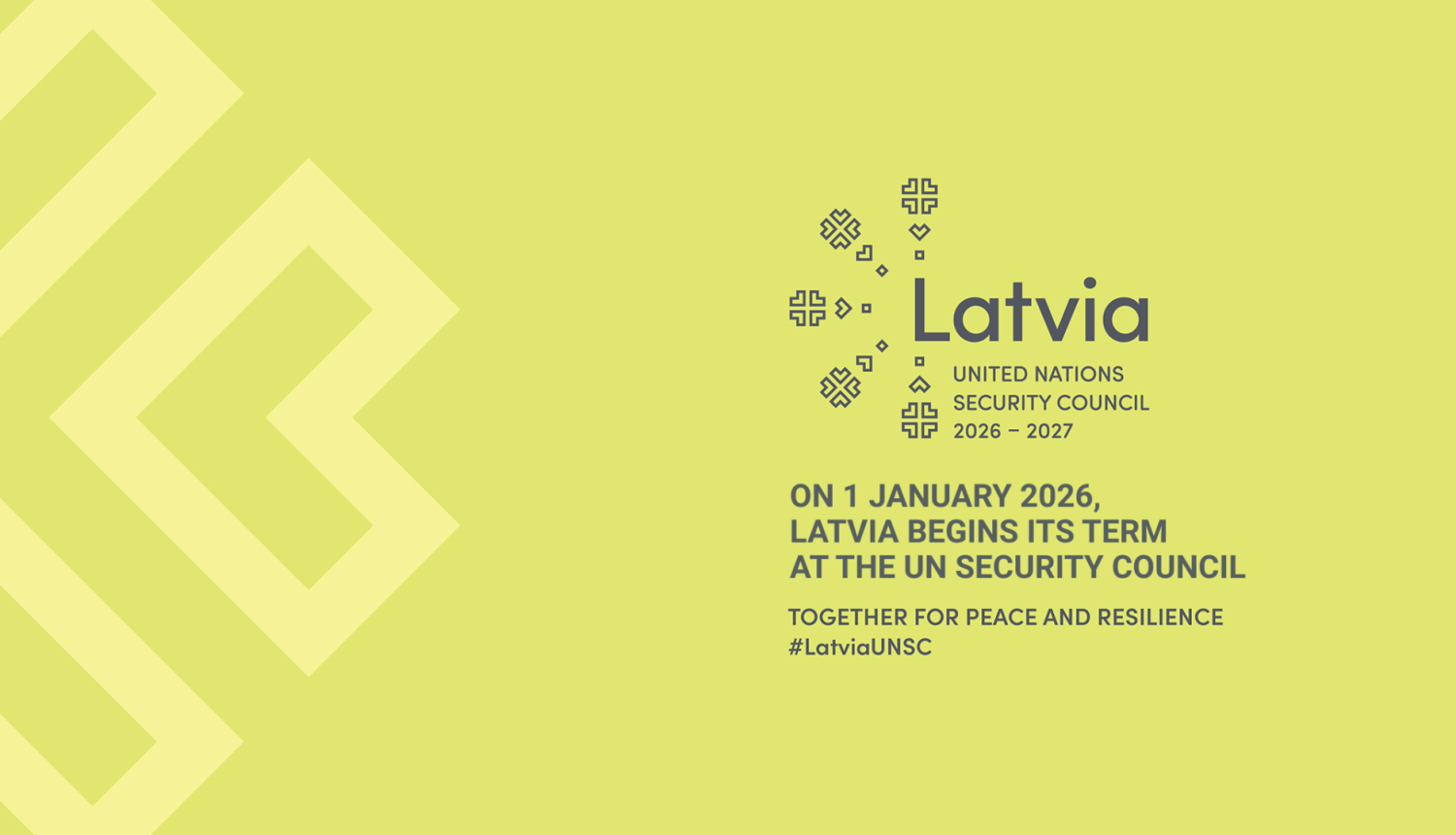
Friday, 10 April 2026, marks 100 days since Latvia began its work on the UN Security Council (UNSC). As a full member of the UNSC, Latvia participates in all regular meetings, decision-making processes, and the formulation of the Council’s positions, addressing international diplomatic issues at the highest level in close cooperation with like-minded countries.
Each month, Latvia, together with its European allies, convenes UNSC meetings on Ukraine, consistently raising issues regarding Russia’s war crimes against the Ukrainian people and civilian infrastructure, the illegal deportation of Ukrainian children, and humanitarian aid for Ukrainian civilians. Latvia uses its position and contacts as a UNSC member to defend its values and principles in the Council’s work and to represent the regional security interests, including in discussions on conflicts in other regions – Africa, the Middle East, and elsewhere. Latvia also counters Russian disinformation and lies in other UN forums.
On its own initiative, Latvia has organised a series of thematic events, including briefings for other elected UNSC members on the humanitarian situation in Ukraine, the EU-UN partnership on international security issues, and new technologies.
The Ambassador of Latvia to the UN, Sanita Pavļuta-Deslandes, notes:
“Following thorough preparations by the team and the ceremonial raising of the Latvian flag on 2 January, our work at the UN Security Council began at a dynamic pace. As early as 5 January, an emergency meeting on Venezuela took place. On 12 January, together with our European allies and Ukraine, we convened an emergency meeting regarding Russia’s massive air strikes, including the use of the Oreshnik ballistic missile.
We are making every effort to keep Russia’s war in Ukraine high on the UNSC agenda, despite the escalation of the security situation in the Middle East and the Gulf region. We are using every opportunity to prevent the normalisation of Russia’s aggression against Ukraine and to highlight Russia’s close military and technological cooperation with Iran. It is essential to continue informing the international community about Russia’s imperialist and colonialist objectives and their global consequences, including security, energy, and food crises, as well as the manipulation and instrumentalisation of citizens from other countries, including Africa, the Middle East, and Asia, by forcing them to go to the front lines to kill Ukrainians.
A just and sustainable peace can only be achieved by exerting pressure on Russia and holding it accountable. We, as country that was occupied by the USSR for more than 50 years, are being heard. Today, we all see the consequences of impunity for the crimes of aggression committed by the leaders of the USSR – they have “inspired” new war crimes. Strengthening Latvia’s security, including through support for Ukraine and the upholding of international law, remains Latvia’s primary goal in the UNSC. This is our day-to-day work – to counter Russia's propaganda and lies, raise awareness among countries around the world about our priorities, and contribute to decision-making within the UNSC. It is reassuring that all UNSC members, with the exception of the aggressor, are calling for an end to hostilities, engagement in peace talks, and are condemning civilian casualties.”
Four years after Russia launched a full-scale invasion of Ukraine, a UNSC meeting on Ukraine on 24 February was accompanied by a session of the UN General Assembly (UNGA) on Ukraine: “Together with our allies and Ukrainian colleagues, we carried out an active lobbying campaign to secure the broadest possible support for the UNGA resolution on Ukraine. It was adopted with the support of 107 countries (14 more than last year). The outcome of the UNGA vote is an important signal from the international community, supporting peace efforts and increasing pressure on the aggressor, which is trying to achieve through “negotiations” what it cannot achieve on the battlefield,” emphasises Sanita Pavļuta-Deslandes.
“The conflict in the Middle East is not merely a regional crisis. We are already feeling its negative impact on a global scale, including due to Iran’s blockade of the Strait of Hormuz. The situation directly affects both Latvia’s and Europe’s security and economic interests, trade, and energy security, through disrupted supply chains, rapidly rising global energy prices, and risks to food availability. Iran’s actions in blocking the Strait of Hormuz are categorically unacceptable and set a dangerous precedent that must neither be tolerated or normalised,” the Ambassador notes.
At an emergency meeting on 28 February, Latvia condemned Iran’s unjustified attacks against countries in the region and its long-standing destabilising actions – Iran has for decades supported, armed, financed, and trained terrorist organisations (Hamas, Hezbollah, the Houthis) and provided support for Russia’s war in Ukraine, systematically violated international obligations, including related to its nuclear programme, and has been extensively involved in circumventing sanctions. Together with 135 countries, we supported the resolution proposed by Bahrain and adopted by the UNSC on 11 March (13 votes in favour, Russia and China abstained). In parallel with Bahrain, Russia proposed a separate resolution calling on all parties to cease military operations in the Middle East and to comply with international law. “On 11 March, the UNSC rejected Russia’s resolution. To support it would be utterly cynical. Russia – a permanent member of the UNSC – itself attacks civilians and has been violating international law on a daily basis for more than four years. Moreover, Iran is currently attacking neighbouring countries with the same weapons it previously supplied to Russia. “Latvia voted against the adoption of this resolution,” says Sanita Pavļuta-Deslandes.
“Latvia is actively involved in all working groups addressing the situation in the Middle East, where there are currently multiple hotspots beyond Iran – including Lebanon, Yemen, the still fragile peace in Syria, the West Bank, the ceasefire in Gaza, and the peace plan that must now be implemented. The security situation across the region remains tense, and any escalation could rapidly expand on a much larger scale, as we are already seeing.
Overall, more than half of the items on the UNSC's agenda relate to Africa, where there are long-standing conflicts, a critical humanitarian situation, and widespread violence against women and children. There have never been as many parallel and interconnected conflicts globally as there are today, and, unfortunately, civilians are the primary victims,” emphasises Sanita Pavļuta-Deslandes.
Latvia’s priorities at the UNSC: (1) to uphold a rules-based international order in accordance with the UN Charter, including achieving a just and lasting peace in Ukraine; exposing Russia’s war crimes, countering the aggressor’s disinformation, and ensuring accountability for the crimes committed; (2) to promote gender equality, advocate for the prevention of sexual violence in armed conflicts, and advance the Women, Peace, and Security agenda; (3) to find solutions to the latest security challenges, including hybrid threats, cyberattacks, AI-related security risks and disinformation. Latvia advocates for improving the work of the UNSC.
Latvia’s first 100 days at the UNSC – facts and figures
Each month, a UNSC member state holds the presidency, chairs all UNSC meetings and promotes its priority issues. Latvia will hold the presidency in November 2026. In April – Bahrain.
During the first 100 days, the UNSC held more than 40 formal meetings, more than 20 consultations [informal, closed-door meetings among UNSC members], and 4 Arria-formula meetings [organised by one or more UNSC members to hear from external experts, NGOs, eyewitnesses, etc.]
JANUARY (Presidency of Somalia)
- 16 UNSC meetings, including emergency meetings on Venezuela and Ukraine.
- 6 consultations (including on Central Asia, Kosovo, the situation in Gaza and the West Bank, South Sudan, meetings on UN missions where Latvian forces are also deployed, etc.).
- 2 Arria-formula meetings. One of them, organised by Somalia, focused on approaches to sustainable peace. The other, organised by Pakistan, focused on the importance of respecting international treaties, during which Latvia highlighted Russia’s actions in Ukraine, which repeatedly violate international obligations.
The situation in the Middle East dominated the agenda, including an open debate organised by Somalia. The focus also included Cyprus, Haiti, Sudan and South Sudan, Central Asia, and Colombia.
FEBRUARY (Presidency of the United Kingdom)
- 12 UNSC meetings, including emergency meetings on Iran and Ukraine. On 24 February, the Minister of Foreign Affairs, Baiba Braže, participated in a UNSC emergency meeting on Ukraine.
- Latvia, together with the United Nations Institute for Disarmament Research (UNIDIR), organised a briefing for 10 non-permanent members of the UNSC on the risks and opportunities associated by new technologies.
- 7 consultations.
- 2 Arria-formula meetings. One of them was organised by Russia in an attempt to spread disinformation about Ukraine. Latvia and the other European countries on the UNSC refuted this. The second meeting was dedicated to Red Hand Day, a campaign against the involvement of children in armed conflicts, in which Latvia emphasised the protection of children, including Russia’s illegal deportation of Ukrainian children.
In addition to its work at the UNSC, Latvia organised a briefing by the UN Office for the Coordination of Humanitarian Affairs (OCHA) for 10 non-permanent members of the UNSC on the humanitarian crisis in Ukraine following Russia’s massive attacks on the energy sector.
Ukraine remained a central issue throughout the month at the UNSC. The regular monthly briefing on the Middle East focused on Palestine, with additional discussions on Yemen and Syria. The meetings on Africa focused on the Central African Republic, Libya, Sudan, and South Sudan. The UNSC extended the mandate of the UN Office for West Africa and the Sahel (UNOWAS). European countries, including Latvia, succeeded in maintaining strong language in the mandate on the Women, Peace, and Security agenda, climate, and sustainable development.
The thematic priorities of the United Kingdom closely aligned with Latvia’s priorities, including the threat of terrorism. Latvia called for focus on preventing the recruitment of young people and children and countering radicalisation through the use of modern technologies. During a briefing on UN police in peacekeeping, Latvia emphasised the role of technology, combating disinformation, and the equal participation of women in security structures.
MARCH (Presidency of the United States)
- 15 UNSC meetings.
- 8 consultations.
- A briefing on Ukraine (23 March), convened with the support of Latvia and its allies. It was chaired by US Deputy Secretary of State Christopher Landau.
- In addition to its work at the Security Council, Latvia, together with Panama, organised a briefing by the Office of the UN High Commissioner for Human Rights (OHCHR) Ukraine Office for 10 non-permanent members of the UNSC on, among other issues, the human rights situation in Russian-occupied territories and the inhumane treatment of prisoners of war and civilians.
- In the context of Latvia’s priorities at the UNSC, Latvia was represented at the 70th session of the UN Commission on the Status of Women by Lauma Paegļkalna, Parliamentary Secretary of the Ministry of Justice.
The UNSC agenda was dominated by developments in the Middle East, including the situation in Syria, Lebanon, Gaza, and the West Bank, as well as Iran and its attacks on countries in the region. Conflicts in Africa and Asia (Democratic Republic of the Congo, Sudan, Myanmar, and Afghanistan) were also in focus.
The United States organised two significant thematic events on the maintenance of international peace and security: 1) on children, technology, and education in conflict, led by US First Lady Melania Trump; 2) on energy, critical minerals and security, led by US Energy Secretary Chris Wright.
APRIL (Presidency of Bahrain)
- The three UNSC meetings held in April (to date) focused on efforts to de-escalate the situation in the Middle East, particularly regarding the blockade of the Strait of Hormuz. On 2 April, meetings were held with the League of Arab States on the situation in Lebanon and with the Gulf Cooperation Council (GCC). At the UNSC meeting on 7 April, Russia and China vetoed a resolution on the situation in the Strait of Hormuz. Latvia, together with 10 other UNSC members, voted in favour of the resolution.
- On 8 April, Latvia, Colombia, and Panama, as co-chairs of the UNSC expert group on climate, peace and security, organised a meeting on the situation in South Sudan. It focused on the impact of the floods on the humanitarian situation and stability in the country.
- In addition to its work at the Security Council, on 9 April, Latvia, in cooperation with the Office of the UN High Commissioner for Human Rights (OHCHR), organised a briefing for 10 non-permanent members of the UNSC on the human rights situation in South Sudan, in preparation for negotiations on the extension of the mandate of the UN Mission in South Sudan (UNMISS) at the end of April.
FACTS ABOUT LATVIA’S MEMBERSHIP IN THE UN SECURITY COUNCIL
- In 2026, Latvia serves on the UNSC alongside the five permanent members (the historical nuclear powers) – the United States, the United Kingdom, China, France, and Russia – and nine non-permanent members: Denmark, Greece, Panama, Colombia, Bahrain, Pakistan, Liberia, Somalia, and Democratic Republic of the Congo.
- The UNSC agenda includes more than 60 various issues related to conflicts and hostilities, specific countries or regions; on topics such as sanctions, international threats, non-proliferation, humanitarian aid, migration, climate security, resource management, sustainable development, and others.
- Latvia’s participation in the UNSC has been one of the long-term goals of Latvian foreign policy. Latvia submitted its candidacy in 2011.
- The rotation of the presidency in 2026 is as follows: May – China; June – Colombia; July – Democratic Republic of the Congo; August – Denmark; September – France; October – Greece; November – Latvia; December – Liberia. The presidency rotates in alphabetical order.
- Latvia was elected to the UNSC for the first time in history on 3 June 2025, with broad support from UN Member States. Election required the support of two-thirds of UN member states, or 129 out of 193 votes. Of the 188 countries that participated in the vote, 178 voted in favour of Latvia (10 countries abstained).
- Latvia began its term on the UNSC on 1 January 2026 and will serve until 31 December 2027.
FOR INFORMATION