
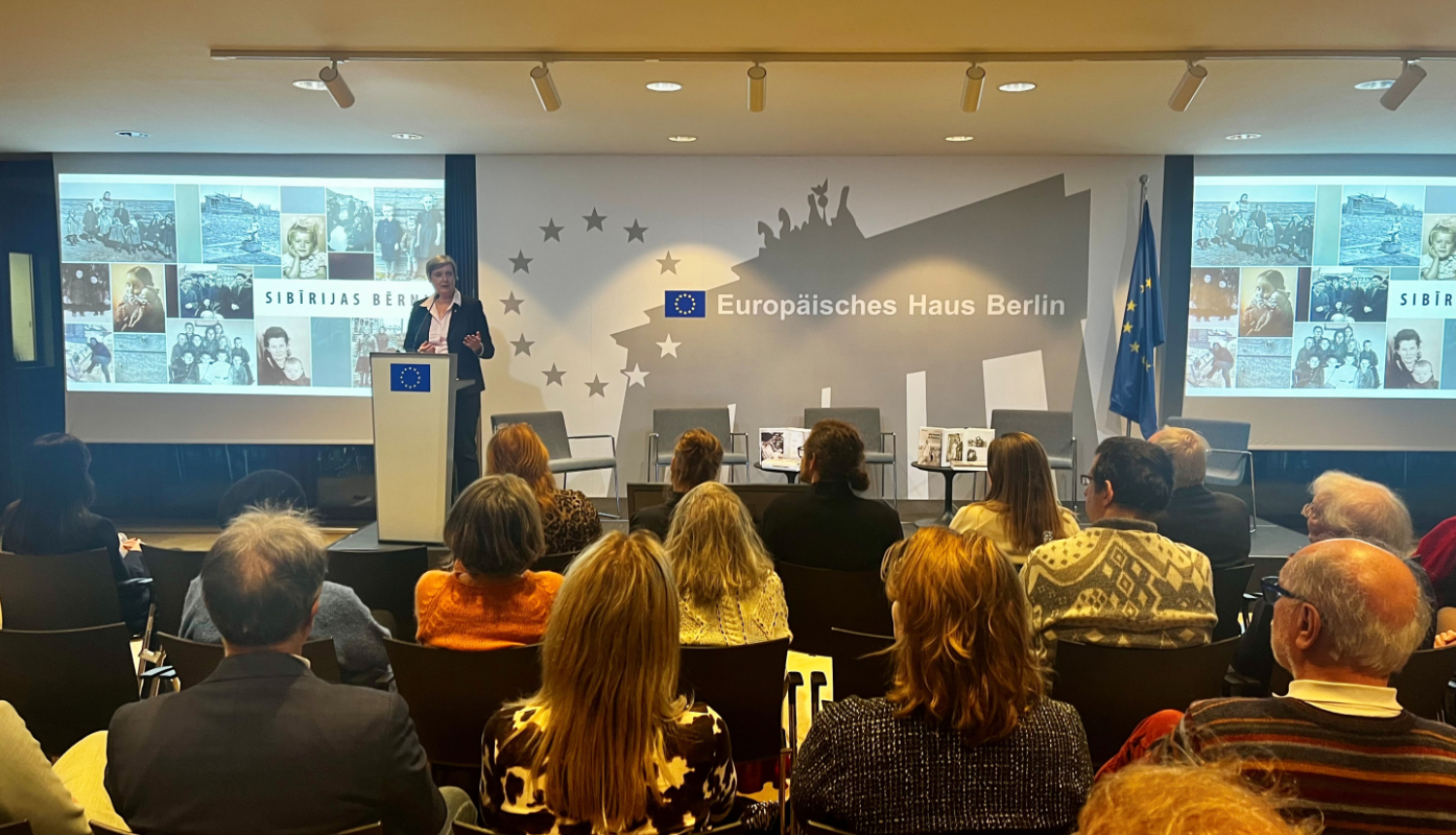
On 25 February 2026, the Embassy of the Republic of Latvia in the Federal Republic of Germany organised a public diplomacy event at the European House in Berlin entitled Latvia’s Bitter Experience of Russian Occupation: Stories from the Past that Warn Europe Today, drawing the international community’s attention to Latvia’s historical experience during the Soviet occupation and its significance in the context of contemporary European security.
The event was opened by Alda Vanaga, the Ambassador of Latvia to Germany, and Barbara Gessler, a representative of the European Commission Representation in Germany. The speeches highlighted the importance of historical memory in reinforcing democracy, societal resilience, and awareness of the security threats posed by authoritarian regimes in Europe.
The event was jointly organised by the Embassy of Latvia in Germany in cooperation with The Children of Siberia Foundation, the European House in Berlin, and the European Union programme Citizens, Equality, Rights and Values (CERV), thus strengthening the international visibility of the project and dialogue on the importance of historical memory in today’s Europe.
The event focused on personal testimonies of the 1940 occupation and the 1941 deportations, especially the experiences of women and children in exile in Siberia. The discussion and storytelling session featured Dzintra Geka, the Director of The Children of Siberia Foundation, film director and author, as well as Marija Krūmiņa, Andrejs Pebo, and Mihails Šomers, who were either deported or born in exile. The personal stories were supplemented by excerpts from documentaries, offering deeper insight into the experience of exile, survival, and the preservation of identity under a totalitarian regime.
The event continued with a screening of the documentary …Igarka, Cerība un Taurenis (…Igarka, Hope and Butterfly), directed by Dzintra Geka, with German subtitles. The film reflects the life stories of deported women and children in Siberia and highlights human resilience in the face of historical tragedy. The film screening served as both an emotional and educational starting point for a discussion with the audience about the significance of historical experience in light of current security challenges.
The concluding discussion with the audience particularly highlighted the importance of historical memory at a time when Russia’s aggression against Ukraine is reviving the methods of totalitarian regimes-forced deportations, the destruction of society, and the manipulation of history. It was emphasised that Latvia’s experience is not merely a national historical narrative, but a universal warning to Europe about the dangers of authoritarianism and the need to strengthen societal resilience to disinformation.
The audience comprised members of the international diplomatic community, experts, media representatives, as well as a broad international diaspora and representatives of German society. By specifically addressing German and international audiences, the event promoted a deeper understanding of what it means to live under Russian occupation and how a lack of understanding of historical experience can weaken society’s ability to recognise contemporary security risks.
Through this public diplomacy initiative, Latvia shared its historical experience and expertise in strengthening societal resilience, democratic values, and historical memory, while affirming Latvia’s role as a reliable and responsible international partner, actively promoting understanding of security challenges and the importance of the rules-based international order.
The event was organised as part of the diplomatic programme to support the implementation of Latvia’s priorities during its membership in the UN Security Council and to promote Latvia’s recognition. On 3 June 2025, Latvia was elected to the UN Security Council for the term from 1 January 2026 to 31 December 2027. Serving as a non-permanent member of the Security Council will be one of the key instruments for securing Latvia’s foreign policy interests. The primary objective of Latvia’s membership in the UN Security Council is to safeguard and strengthen an international environment that supports the security of Latvia while seizing and maximising the potential offered through multilateral diplomacy.