

 Flickr
At the NATO Summit of Heads of State and Government in Ankara, Allies reaffirmed the importance of collective defence – Article 5 – and agreed to continue support for Ukraine this year and next in the amount of at least USD 140 billion. The Allies also agreed to accelerate the development of NATO’s capabilities, based on lessons learned from the war in Ukraine, new technologies and a stronger defence industry. Latvia emphasised the significance of air defence, anti-drone capabilities, long-range weapons, hybrid threats and the risks posed by Russia’s shadow fleet to Baltic security.
“Every day, Ukraine’s defenders demonstrate how modern warfare is evolving. The development of NATO’s capabilities must be based on real combat experience – in drones, anti-drone capabilities, air defence and technological superiority,” the Minister of Foreign Affairs, Baiba Braže, emphasised at the NATO summit, noting that these capabilities are essential for the security of NATO’s eastern flank, including the Baltic region.
At the Summit, the Allies unanimously identified Russia as a long-term threat to the security of the Euro-Atlantic area. The Minister stressed that Russia’s hybrid threats, including sabotage, cyberattacks, disinformation and the instrumentalisation of migration, are part of its war doctrine and require close coordination among Allies.
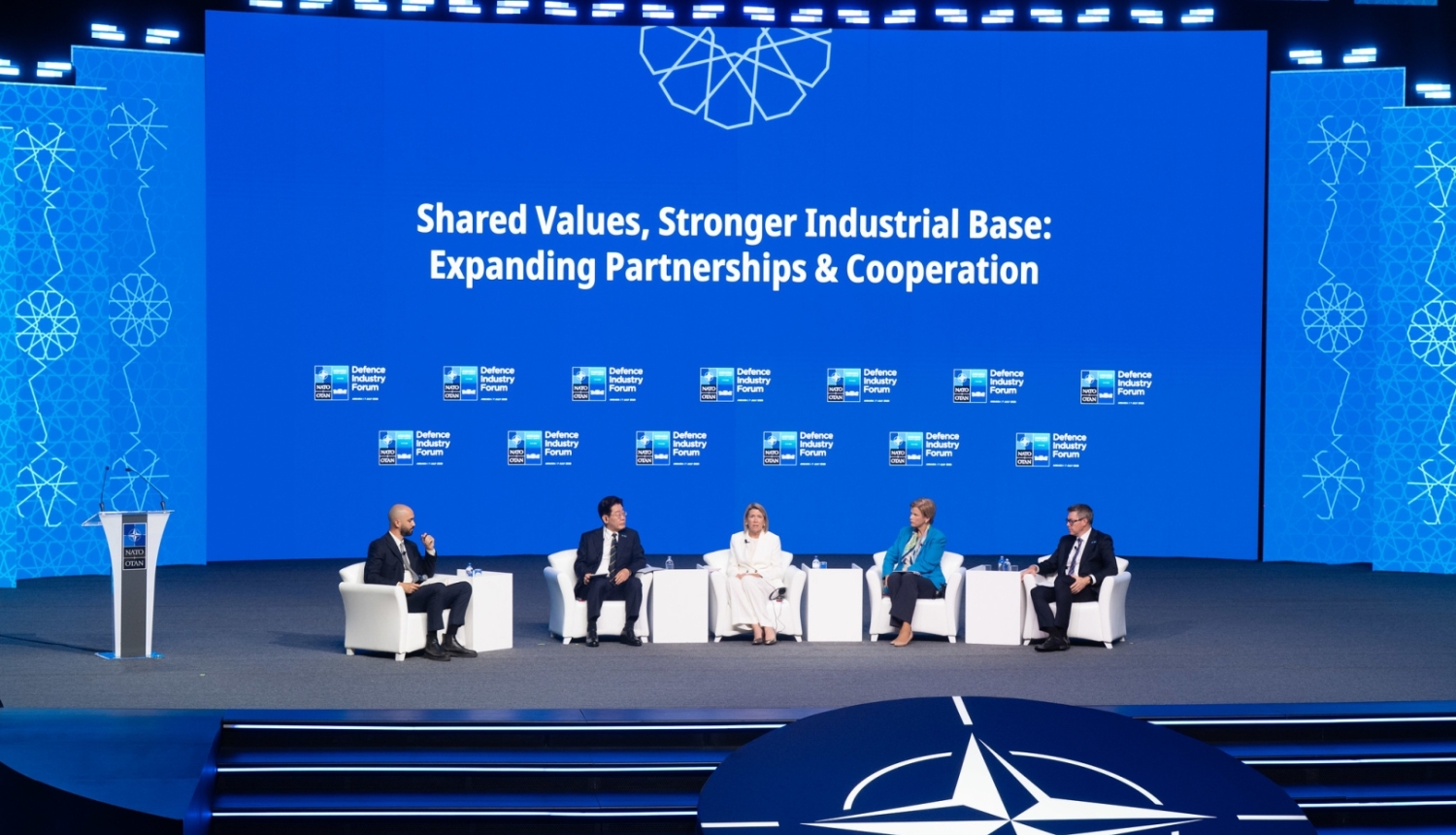
In Ankara, special attention was also paid to strengthening the transatlantic defence industry. At the NATO Defence Industry Forum, Allies announced new joint capability contracts and multinational cooperation projects. Latvia was represented at the forum by LMT and Ammunity, as well as the Latvian Federation of Security and Defence Industries.
Latvia joined Canada’s initiative to establish a Defence, Security and Resilience Bank to improve access to long-term financing for small and medium-sized enterprises in the defence industry. At the Summit, leaders from the nine founding countries, including Latvia, issued a joint statement, committing to establish the bank by 2027.
Latvia also emphasised the importance of security in the Baltic Sea, particularly the security-related, economic and environmental risks posed by Russia’s shadow fleet. Latvia advocates for tighter restrictive measures against Russia’s shadow fleet and its support network to reduce sanctions evasion and risks to critical maritime infrastructure.
At the Summit, leaders reaffirmed their commitment to continuing predictable military support for Ukraine in the long term. The Allies also assessed the implementation of the agreements reached at the Hague Summit regarding the increase in defence spending. Latvia already allocates 4.91% of its GDP to direct defence spending, while defence-related spending accounts for 1.4% of GDP.
As part of the Latvian delegation led by President Edgars Rinkēvičs, Foreign Minister Baiba Braže was on a working visit to Ankara from 6 to 8 July 2026, participating in the NATO Summit, a meeting of the NATO-Ukraine Council, the meeting between NATO Foreign Ministers and the Istanbul Cooperation Initiative partner countries, and several discussions on international security policy.