
 Flickr
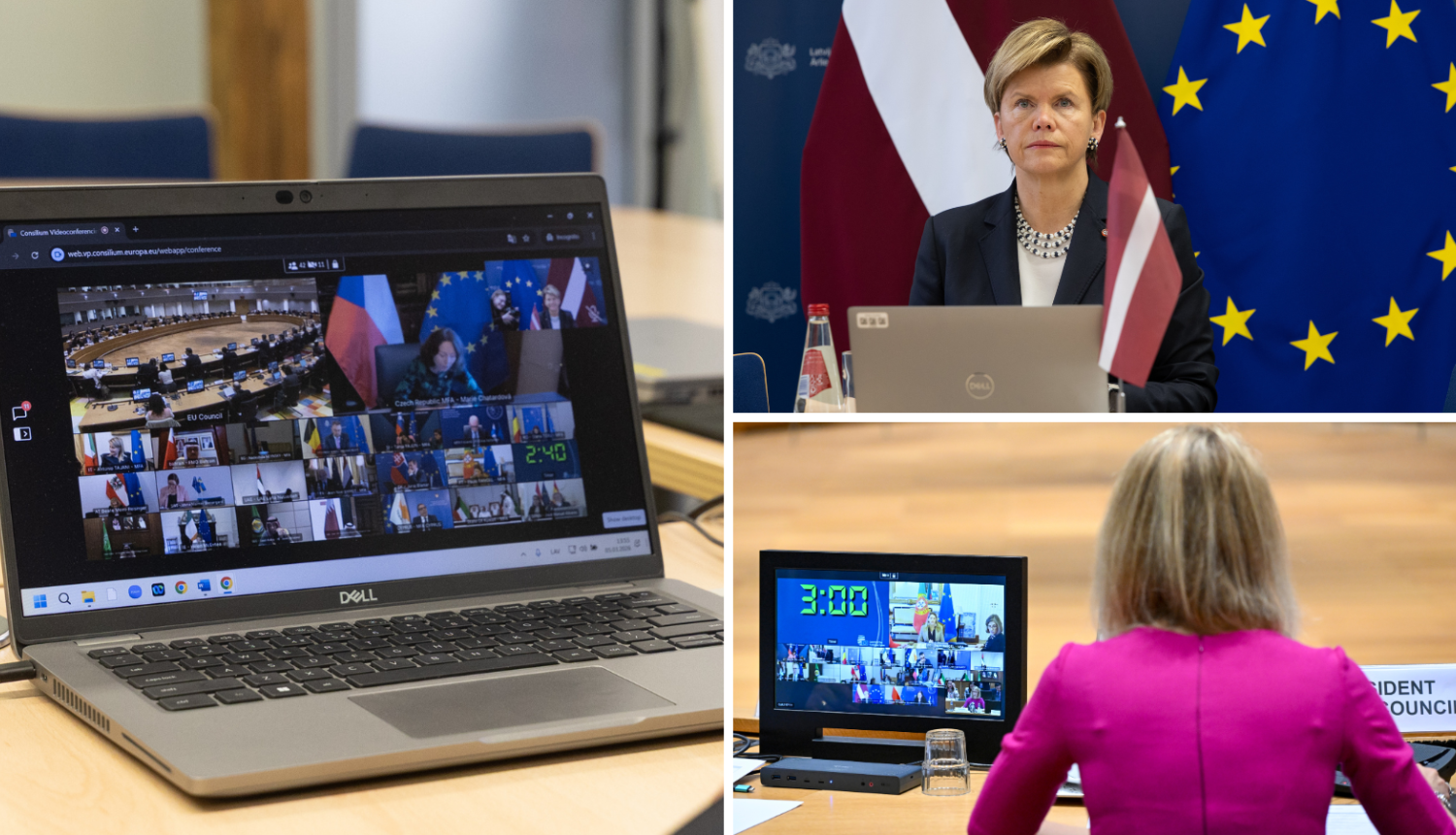
On 5 March 2026, at a meeting of the Foreign Ministers of the European Union and the Gulf Cooperation Council convened by EU High Representative, Kaja Kallas, to discuss the present situation in Iran and the Middle East, the Minister of Foreign Affairs, Baiba Braže, emphasised that Latvia strongly condemns Iran’s unprovoked attacks on countries in the Middle East and the Gulf region, which pose a threat to regional and international peace and security and violate the sovereignty and territorial integrity of the countries in the region. The Foreign Ministers of the European Union and the Gulf Cooperation Council adopted a joint statement[1].
B. Braže pointed out that Latvia expressed its strong condemnation of Iran’s unprovoked attacks on countries in the Middle East region at the UN Security Council.[2]
The Minister of Foreign Affairs, Baiba Braže:
“Latvia stands in full solidarity with both the Iranian people and those in the countries affected by Iran’s attacks.
We deeply appreciate the resilience shown by countries in the Middle East and the Gulf region in withstanding and repelling Iran’s attacks. I informed the ministers of the Gulf region about Latvia’s achievements in drone technology and that we can provide the countries in the region with anti-drone systems developed in Latvia.
The priority now is to ensure the protection of civilians, avoid a wider regional conflict, and prevent further escalation of the situation. Stability in the region is essential for global security.”
It was noted by B. Braže that Iran has consistently and deliberately acted to disrupt stability both in the Middle East and globally, including by providing direct assistance to Russia in its war against Ukraine. Iran is using Shahed drones in its attacks on countries in the Middle East and the Gulf region – the same drones it has supplied to Russia for its aggression in Ukraine.
The Minister emphasised that Iran has repeatedly violated its international commitments and posed a threat to global peace and security. For decades, it has supported, armed, financed, and trained terrorist groups, including Hamas, Hezbollah, and the Houthis. The Iranian regime has openly maintained its unlawful nuclear programme despite repeated diplomatic efforts by the EU, the United Kingdom, and the United States. Iran has been extensively involved in circumventing sanctions. It has also threatened EU countries in connection with moves to list the Iranian Revolutionary Guard Corps as a terrorist organisation.
Latvia has repeatedly condemned the actions of the Iranian regime, including its failure to cooperate with the international community and the International Atomic Energy Agency (IAEA) regarding its unlawful nuclear programme. For example, at an emergency meeting of the IAEA Board of Governors on Iran this week, on 2 March, IAEA Director General Rafael Grossi stated in his announcement that Iran had persistently prevented the Agency’s experts from conducting the necessary on-site inspections required by Iran’s commitments under the Treaty on the Non-Proliferation of Nuclear Weapons.[3]
Latvia has joined the EU’s joint statement on the situation in the Middle East.[4] Latvia is carefully monitoring the unfolding events in the countries in the Middle East and the Gulf region and maintains regular contact with its embassies, EU Member States and other countries. Since 28 February, B. Braže has spoken by telephone with the Foreign Ministers of Israel, Jordan, Kuwait, Azerbaijan, and Armenia.
[1] Joint statement by GCC-EU Ministers’ meeting on recent developments in the Middle East: Iran’s attacks against GCC states | EEAS
[2] Permanent Mission of the Republic of Latvia to the United Nations
[3] IAEA Director General’s Introductory Statement to the Special Session of the Board of Governors
[4] Statement by the High Representative on behalf of the European Union on developments in the Middle East