
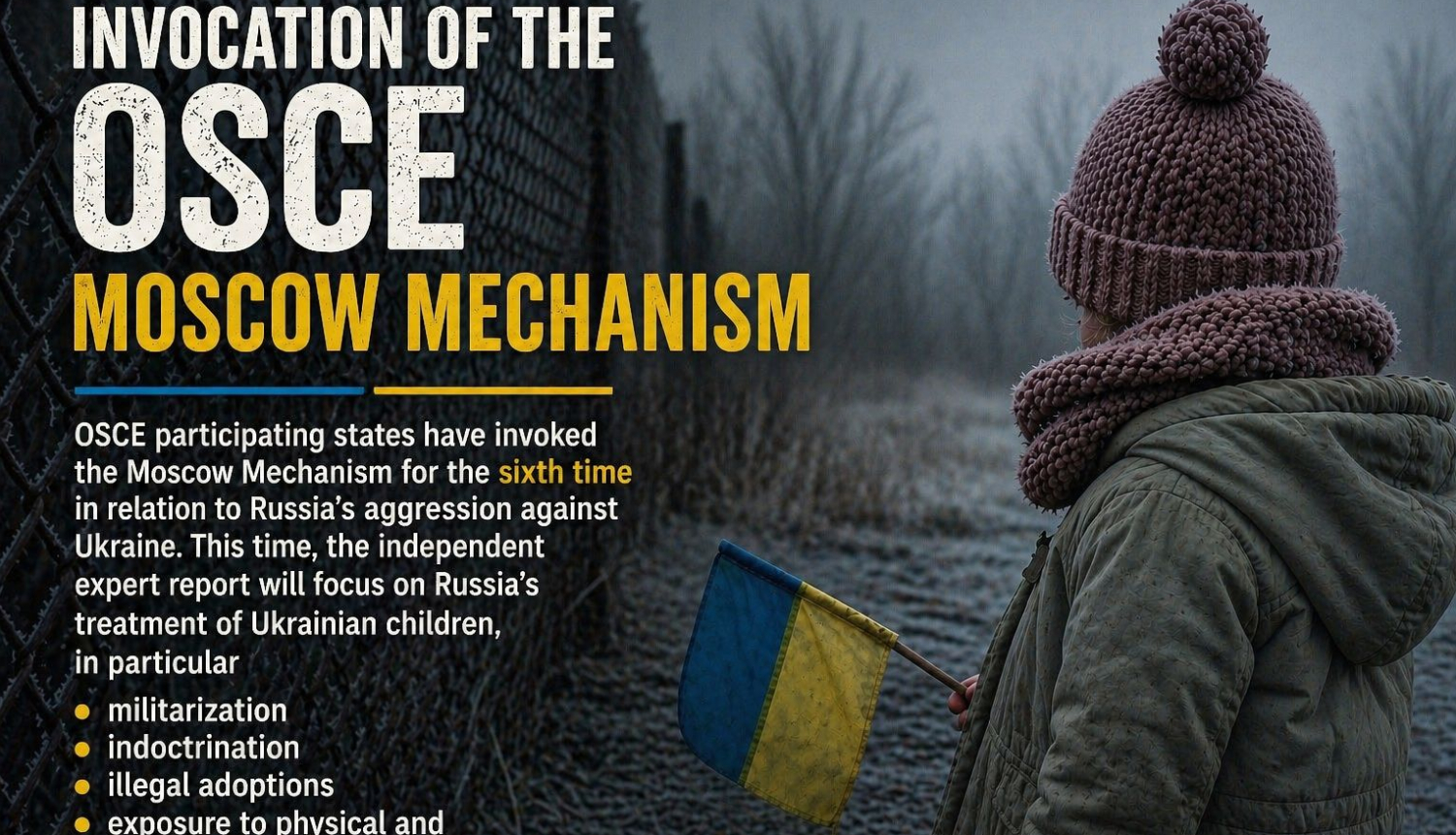
On 14 May 2026, at the Permanent Council of the Organisation for Security and Co-operation in Europe (OSCE), 41 participating States, including Latvia, with the support of Ukraine, call to establish an independent expert mission (the Moscow Mechanism) to assess violations of human rights and international humanitarian law related to the indoctrination and militarisation of Ukrainian children in the temporarily occupied territories of Ukraine and the Russian Federation.
Referring to the 2023 OSCE expert report on the “Forcible Transfer and/or Deportation of Ukrainian Children to the Russian Federation”, the OSCE is expected to establish an independent expert mission in the near future to gather facts and evidence regarding possible violations of OSCE commitments, as well as violations of human rights and international humanitarian law against Ukrainian children in the temporarily occupied territories, including illegal adoption, physical and emotional abuse and indoctrination aimed at erasing Ukrainian identity and imposing loyalty to the occupying power.
This is the sixth time since the Russian Federation’s full-scale invasion of Ukraine that the Moscow Mechanism has been invoked within the OSCE. Previous reports have documented the torture of Ukrainian civilians and prisoners of war, the forcible deportation of children, attacks against civilians, and repression in the temporarily occupied territories of Ukraine.
Information contained in the mission experts’ report may also be used in international courts and tribunals that currently have, or may have in the future, jurisdiction over these crimes.
The Moscow Mechanism is an OSCE instrument applied in cases where there are concerns about serious threats to compliance with OSCE Human Dimension commitments in one of the OSCE participating States. The mechanism takes the form of a fact-finding and documentation mission in the country concerned, resulting in a report that is subsequently reviewed by the OSCE Permanent Council.